
Sakharov Prize side event: An end to impunity for attacks on aid workers
Accountability & Rule of Law - Global - Advocacy - Legal Aid & Empowerment - Technical Assistance
On 17 December 2025, a side event to the Sakharov Prize ceremony in Strasbourg gathered survivors, humanitarian organisations, Members of the European Parliament and EU institutions to call for stronger protection of aid workers, and proper accountability for crimes against them.
In 2024 alone, 861 aid workers suffered major security incidents, and 383 lost their lives — many of them deliberately targeted because of their work. Crises in Sudan, Myanmar, Ukraine, Gaza, Ethiopia, Yemen, and beyond show that the threat is global, and growing.
Protect Aid Workers
The Sakharov Prize is the European Union’s highest recognition for outstanding human rights work, and this year, the European Parliament nominated “Journalists and Humanitarian Aid Workers in Palestine and all conflict zones”, represented by the Palestinian Journalists Syndicate, the Palestine Red Crescent Society (PRCS), and UNRWA, as finalists.
Opening the event, Hadja Lahbib, European Commissioner for Equality, Preparedness and Crisis Management, highlighted the courage and incredible commitment of aid workers on the frontlines. She underlined the Commission’s intention to make PAW a permanent EU tool, stressing that attacks on humanitarian personnel are not collateral damage, but war crimes that demand accountability. She also reaffirmed the EU’s commitment to keeping aid worker safety high on the political agenda.
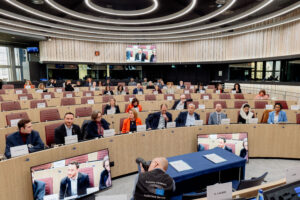
Isabella Lövin, Vice-Chair of the European Parliament Committee on Development, introduced the Protect Aid Workers (PAW) programme, established by the European Commission as a rapid-response mechanism to support humanitarian workers who experience critical incidents in the line of duty. Since its launch in 2024, PAW has assisted over 400 aid workers across 15 countries, providing emergency relocation, medical care, psychosocial support, financial assistance, and legal aid.
Testimonies from the Field
Key contributors at the side event were survivors themselves – and their testimonies underscored the human cost of inaction.
Parasto Hakim, founder of the Afghan SRAK Educational Association, spoke of the risks faced by human rights defenders in Afghanistan and called for sustained protection and support so that their work can continue.
Mykola Obelchak, a Ukrainian volunteer with the humanitarian mission Prolyska, described being injured by a cluster munition while helping a civilian, and detailed the constant threats faced by aid workers in Ukraine and the lack of adequate protection despite the risks they carry daily.
Hanin Ahmed, External Relations Officer for Sudan’s Emergency Response Rooms, was forced to flee due to threats and fear of sexual violence. She described PAW as a lifeline, sharing how survivors of brutal attacks are now recovering thanks to the support provided. “You answer the messages I receive everyday from my colleagues in Sudan. You save lives,” she said, urging decision-makers not to forget Sudan.
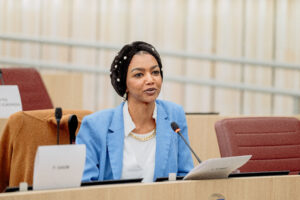
Hanin Ahmed, External Relations Officer for Sudan’s Emergency Response Rooms
Olivier Vandecasteele, founder of Protect Humanitarians, shared harrowing details on his 465 days detention in Iran. He called for better psychological support for aid workers, not only after incidents, but also before they happen.
Nine members of The Palestine Red Crescent have been killed in 2025 alone, and Dr Younis Al-Khatib, PRCS President, stressed that accountability for these attacks remains absent. He warned that respect for international humanitarian law alone is not enough if it is not enforced. “The (Red Cross/Red Crescent) emblem is not a bullet-proof vest,” he said, emphasising that humanitarian workers are trained to save lives, not to lose their own.
Marc Lassouaoui, Senior Manager for Outreach Europe at UNRWA, highlighted that colleagues on the ground are the real heroes, yet those delivering aid are increasingly the ones who need help themselves. He also warned that disinformation campaigns are placing humanitarian staff at further risk and called for international law to be upheld at all times.
Speaking on behalf of ECHO implementing partners, Mette Petersen, Director of the EU Office of the Red Family Fund at IFRC, highlighted the urgent need for better data, particularly on national staff, and for sustained psychosocial support for those working under constant fear and inhumane pressure. She stressed that protecting humanitarian personnel is not optional — it is a legal and moral imperative.
Leire Pajin, European Parliament Standing Rapporteur for humanitarian aid, stressed the courage of aid workers on the frontlines and survivors in the room, agreeing that it is an absolute priority to ensure that aid workers can deliver lifesaving humanitarian support safely.
Putting Commitments into Action
Legal Action Worldwide (LAW) is a partner of PAW, delivering legal assistance to aid workers and their families. For example, LAW provided legal support to Mustapha Djemali, an 81-year-old aid worker detained for 18 months in Tunisia for helping refugees, and his colleague Abderrazek Krimi. Both were released in November 2025.
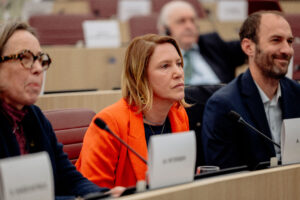
Antonia Mulvey participating in the Side Event to the Sakharov Prize ceremony on the Protection of Humanitarian Personnel. European Parliament, Strasbourg, France, December 17, 2025.
LAW’s Executive Director, Antonia Mulvey, outlined a clear call to action with three urgent priorities, warning that silence and inaction only fuel further violence:
- Ensure consequences for states and non-state actors who commit grave violations of international humanitarian law — legal frameworks exist and obligations are clear.
- Increase support for mechanisms such as Protect Aid Workers to provide life-saving medical, psychosocial, and legal assistance.
- Put survivors’ voices at the centre of all initiatives and decision-making, ensuring those most affected shape the response.
The challenge now is to turn these commitments into action — so that this time next year, 2026 is not marked, yet again, as the deadliest year on record for humanitarian personnel.
LAW provides free legal information, assistance and representation to aid workers, their families, and humanitarian organisations. Please contact us at [email protected] or on WhatsApp or Signal at +41763962858. All communications and consultations are free and will be treated confidentially.