
World Press Freedom Day: Attacks on journalists are attacks on international law
Accountability & Rule of Law - Global News - Global - Ukraine - Advocacy
Every 3rd of May marks World Press Freedom Day. It is a day to celebrate the principles of independent journalism, assess the state of media freedom worldwide, call to stop attacks on journalists, and to honour those who have lost their lives in the line of duty.
Today, press freedom is in grave decline worldwide. According to Reporters Without Borders, global press freedom has fallen to its lowest level in 25 years. In 100 out of 180 countries, conditions for journalists have worsened.
Armed conflict, violence, and aggression invariably make these conditions even worse. Committee to Protect Journalists reported that 129 journalists and media workers were killed in 2025. At least 104 of them were killed in conflict-affected areas. While the number of journalists killed in Ukraine and Sudan increased, the majority were Palestinians killed by Israel. In Gaza, at least five journalists were killed since the beginning of 2026, adding to a devastating toll since October 2023, amounting to more than 220 journalists killed.
The rising number of journalist deaths globally is fuelled by a persistent culture of impunity for attacks on the press. Very few transparent investigations have been conducted into the 47 cases of targeted killings in 2025, and no one has been held accountable in any of the cases.
Countries such as Iraq, Sudan, and Yemen provide the lowest security levels for journalists due to persistent violence and instability. Similarly, Russia’s war against Ukraine has reinforced its position as one of the most repressive environments for journalists, where anti-terrorism and anti-extremism laws are routinely used to silence reporters.
Amid this picture, Ukraine stands out as a relative exception. According to Reporters Without Borders, despite the ongoing war, the country has improved its press freedom ranking in 2026 compared to 2025, moving from 62nd place to 55th. However, the risks remain high: eight journalists were killed in Ukraine in 2025 alone.
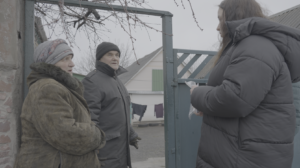
Investigative journalists in Ukraine document Russia’s war crimes in Kyiv region after deoccupation in 2022. Photo: courtesy of Myroslava Chaiun
In Ukraine, we spoke to Myroslava Chaiun, an investigative journalist at Kyiv Independent, who covers war crimes, issues related to occupation, human rights, and corruption.
In the context of an armed conflict, how would you describe the current state of press freedom in Ukraine?
I would describe the level of freedom of speech in Ukraine as stable, thanks to the work of independent journalists who continue to strengthen government accountability to the public. At the same time, over these years of work I have noticed that freedom of speech in Ukraine is constrained by the officially imposed martial law. For example, journalists must obtain permits to film at certain critical infrastructure assets. There are also cases when officials deny media representatives access. Sometimes this is justified by claims that it is too dangerous for journalists to work there. Meanwhile, in the territories of Ukraine occupied by Russia, the situation regarding freedom of speech is critical. Journalists who try to report the truth are illegally imprisoned and tortured. It pains me that we cannot report directly from the ground about the conditions people are living in under occupation.

Myroslava Chaiun, investigative journalist at Kyiv Independent in Ukraine. Photo: courtesy of Myroslava.
Journalists are protected under international humanitarian law (IHL) as civilians and can’t be targeted. How does this legal protection compare to your experience in practice?
Since 2014, Russia has demonstrated that in this war it ignores all rules — it does not care whom it attacks: journalists, medics, or children. The word “PRESS” offers no protection; instead, it makes us visible targets.
With the rapid development of FPV drones, an urgent issue has become whether journalists should be allowed to carry drone detectors — devices that could at least provide some level of protection while working near the front line. However, as far as I know, international law does not permit the use of such equipment.
What motivate you to continue your work as a journalist in this context?
I report on the war so that those affected by it do not feel alone with their experiences and struggles. So that Ukrainians — and the world — know and remember what is happening. I feel an inner responsibility to continue this work, despite the challenges.
Attacks on journalists, such as those on civilians, are attacks on international law. They are direct threats to the rule of law that can’t remain unanswered. Member states have the responsibility to ensure that those protected by international humanitarian law (IHL) are indeed shielded from abuses violence. These are binding rules, not a menu to choose from.