Universal Jurisdiction and the Pursuit of Accountability in the Asia-Pacific
Accountability & Rule of Law - Rohingya Crisis - Advocacy - Strategic Litigation
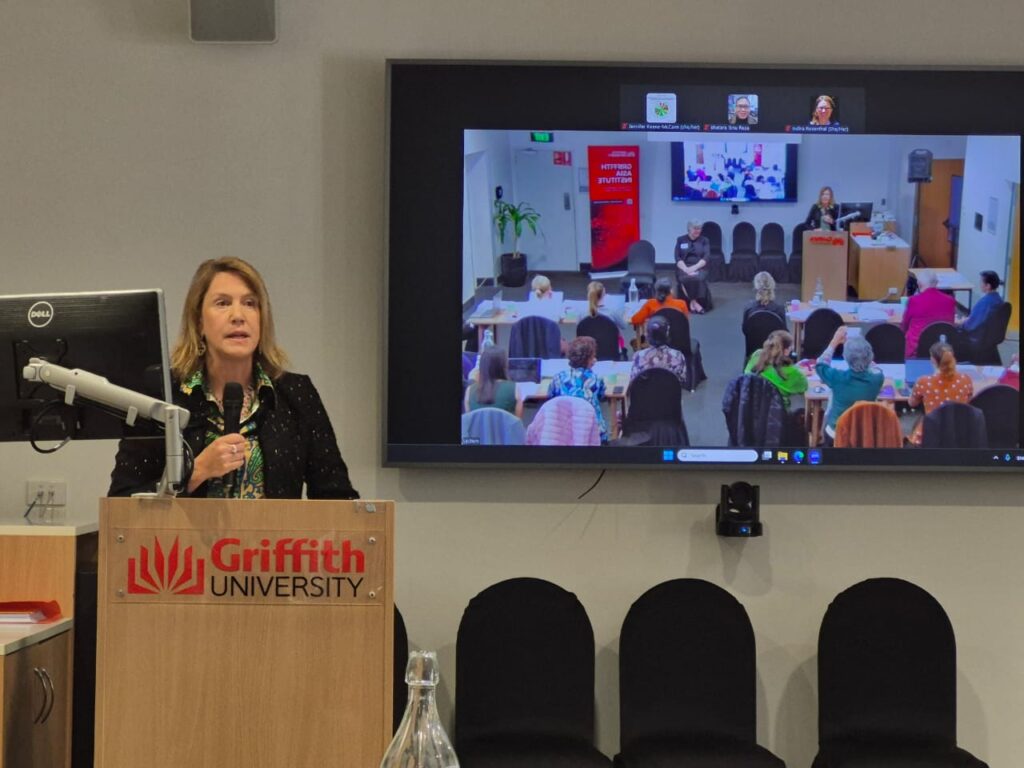
Keynote Address
Brisbane, Australia 20 May 2026
Two-days workshop “Prosecuting Asia-Pacific International Crimes in Domestic Courts”, organised by Griffith University and Asia Justice Coalition
Antonia Mulvey
Founder & Executive Director, Legal Action Worldwide (LAW)
Good morning – It is a great pleasure to be here – in this region, at this moment. Thank you very much to Griffith University and the Asia Justice Coalition for the invitation.
We come together at a time that the international commitment to international law, international justice institutions and human rights is challenged in an unprecedented manner. We come together at a time when the number of conflicts has increased, and the number of displaced people is at an all-time high. And we come together at a time when using the law to protect people’s rights and to demand justice and accountability has arguably never been so important and so difficult.
Today I want to share with you how working directly with victims and survivors of international crimes and human rights violations in this region can create both changes in the law but equally – and for them more importantly- changes to foster a better future for survivors, their families, and their communities. And how women can be, and are, at the forefront of these changes.
To do this – I want to take you back to the beginning of September 2017, when I found myself on the Myanmar/Bangladesh boarder when the Myanmar military were carrying out massive attacks – known as the ‘clearance operations’ – against the Rohingya community in Rakhine State. It was total and complete chaos as hundreds of thousands of people crossed the border into Bangladesh in a just few weeks– half of them were children.
Everyone was desperate, hungry, traumatised, many of them were injured. Children were without any clothes. Gunshot wounds and machete wounds were visible on so many people – and you could see the smoke of their villages still burning in Myanmar. And civilians had fled their villages into literally nothing– there were no medical facilities, no food distribution centres, no shelters – there was no hope.
I sat in this chaos, day after day listening to the stories of Rohingya woman and children who had survived what the Myanmar military had done to them, their families, their communities, and their villages. Mothers described how they had to choose which child lived and which dies – and they asked me how is it possible to make such a choice, and how could they live with themselves. It is a testament to the human condition that people can endure so much pain and still survive – both physically and mentally. They described such horrors that they will be etched into my mind forever.
And as I sat with them – they kept asking me the same question “Will you get me justice ?’ And one of the women, let us call her Shahida, at the end of our conversation —looked me directly in the eye and — asked me another question. Not for help. Not for food, or money, or even safety. She asked me very quietly: “Will anyone ever know what has happened to us?”
As a lawyer and an investigator, you are trained to listen and interview but rarely to give answers to so many of these questions. At the time I truly wondered how justice for these women and children would ever be possible. Their questions reverberated in my head for years.
When I interviewed Shahida and more than 150 women and children in what is now the largest refugee camp in the world, I was an investigator for the United Nations Independent International Fact-Finding Mission on Myanmar. My file was to investigate sexual and gender-based violence and crimes against children. I do not need to describe to this audience what we found. Some of you have written your own reports about it. Some of you shouted about it for years before anyone in the West was prepared to listen. In sum – The Myanmar military burned villages. They gang raped women in front of their children. They killed those children.
We recorded all of this in the UN Fact Finding Mission 2018 report, and we found that there were reasonable grounds to conclude that genocide, crimes against humanity and war crimes should be investigated and prosecuted. We named the names of those most responsible. We listed the units most responsible. We laid out the chain of command. And then we did what fact-finding missions do, which is hand the file over and hope that, somewhere, somebody, in some jurisdiction, would have the courage to pick it up.
And to my amazement, in one year – they did.
In November 2019, in act of moral and legal clarity, The Gambia, a small West African country, far from Rakhine state, decided to stand up for its Rohingya brothers and sisters and initiated proceedings against Myanmar for the breach of the Genocide Convention at the International Court of Justice (ICJ) in the Hague. It was the first time that a third-party state had initiated proceedings in this way at the Court. In their application, the Gambia heavily relied on the UN 2018 Independent International Fact-Finding Mission on Myanmar report, and the stories of the survivors.
In December 2019, I went to the International Court of Justice in the Hague with a Rohingya victims delegation from the camps in Cox’s Bazaar, Bangladesh, to hear Gambia’s request for provisional measures against Myanmar. We were to face Aung Sung Su Ki at the court – who at the time was representing Myanmar.
The victims delegation included women who had been raped and whose husbands and children had been killed by the Myanmar military. They had never been on a plane before, in a car, in a bed, used a key – the list of ‘nevers’ was endless. When we arrived at the court in the Hague it was extraordinary – they were so close to Aung Sung Su Ki that they could almost touch her. The courage of these women was impressive. And Aung Sung Su Ki – a woman who had inspired me to be a human rights lawyer –was now representing one of the most ruthless militaries in the world.
Provisional measures were ordered against Myanmar by the International Court of Justice. We cheered and we couldn’t believe it. But as you know, this was only the start as Myanmar breached those provisional measures repeatedly. There is rarely a panacea in international justice – but it was a start.
Then my organisation, Legal Action Worldwide, worked with the Gambia from 2019 for more than six years, collecting hundreds of pages of survivor testimony, particularly from women, which were submitted to the court. And on 12 January 2026, finally, we were back at the International Court of Justice for the merits hearings – the full hearing of the case. The first Genocide case the Court had heard in over a decade. Eleven intervening states stood alongside The Gambia. No intervening states stood alongside Myanmar.
Again, I was representing the Rohingya victims delegation from Cox’s Bazaar, but this time, I was also representing three survivors that would give key evidence: in person testimonies – something that we had pushed for. We were in court for three weeks – Gambia read out testimonies of survivors from the UN reports and from Legal Action Worldwide. The victims delegation listened daily to the denial of Myanmar about what happened to them and their families. It was painful and harrowing.
Then came the turn of the three witnesses – all survivors – who gave evidence over three days of what they had endured, in closed sessions. When each witness walked into the court, they showed the type of courage and dignity I have rarely encountered as they described the worst days of their lives. NJ, who was gang raped and her child killed and husband taken by the military; MN the sole survivor of a massacre where 87 people were killed; and MS who spoke of the last time he saw his wife and five children, and more than fifty members of his family killed. The court was so quiet, you could hear people weeping – the 15 Judges watched and listened to them intently. Despite the darkness of their ordeal, all the witnesses described a lightness after giving evidence.
The court staff said they had never heard such accounts in the court. The power of the witnesses was recognised in the court by the UN Special Rapporteur on Myanmar.
We don’t know what the judgement will be as the Court is now deliberating – but we are cautiously optimistic.
What happened at the Court in The Hague this January is critical. Whatever the judgment, the Rohingya women have been heard at the highest forum of the Genocide Convention. And the interventions of so many states — Canada, Denmark, France, Germany, the Netherlands, the United Kingdom, the Maldives, Slovenia, the Democratic Republic of the Congo, Belgium, Ireland — tells us something – states do care and they can act.
It is also worth noting that Myanmar had an army of lawyers at the court – whilst breaching international law on a daily basis, no one, including Myanmar, want to be found liable for genocide. This is not always the situation. This was not the case in Syria, where they didn’t even bother to attend the court when a case was taken against them on breach of the torture convention.
Gambia has upheld state responsibility, but now, let’s turn to individual responsibility and the role of national courts – and the use of universal jurisdiction.
Yesterday we heard about the Argentina case. In brief, a few things that I want to highlight.
In November 2019, the Burmese Rohingya Organisation UK, BROUK represented by Tomas Quintana filed a complaint in Buenos Aires. It was rejected at first instance. It was reinstated on appeal. By November 2021, a criminal investigation was open. And in June 2023, seven Rohingya survivors testified in person before the Argentine court, the first time Rohingya survivors had appeared physically in a court of law to give eyewitness testimony about alleged genocide and crimes against humanity committed against them.
Legal Action Worldwide represents six of those witnesses – one man and five Rohingya women – all of whom had been subjected to sexual violence or had witnessed it. The women bravely told what had happened to them – horrific accounts relived for the court. Following their testimony and important evidence submitted by the IIMM in June of 2024, the Argentine federal prosecutor asked the court for arrest warrants — 25 of them in fact, for military and civilian officials, for genocide and crimes against humanity. And on the 13th of February 2025 — a Thursday — Judge Servini signed them.
Names that, in 2017, we said with despair because they were untouchable. Names that are now international fugitives in the eyes of an Argentine court, and we hope soon in the eyes of Interpol.
I greeted the women when they returned from giving evidence and one of them told me ‘Who would have thought it would be us – the Rohingya women who will hold the Myanmar military to account – I can’t believe it.” I hugged her – she cried –so did I, silently.
It is one of the strange and beautiful facts of this work that justice for the Rohingya passes through Buenos Aires. There are reasons for it. Argentina knows what military impunity looks like from the inside. Argentina has built its post-junta legal culture around the principle that perpetrators of mass atrocity do not get to retire, do not get to be forgotten, do not get to die in their beds with their medals on. The Argentine constitution, in Article 118, gives universal jurisdiction unusually strong footing for the gravest crimes.
This is the first universal jurisdiction case anywhere in the world to issue arrest warrants for the Rohingya genocide. The first.
A word of caution however, I do not want to oversell it. The Myanmar commanders are not in a cell. And currently, Interpol states that a red notice cannot be issued for Min Aung Hlaing because of state immunity and he remains is in a palace. Argentina cannot drag them out of Naypyidaw. The Interpol red notice will be ignored by the regimes that protect them — Russia, China, the regimes that have decided that Myanmar is a useful place to do business and an inconvenient place to ask questions. They will not be on a plane to Buenos Aires next week.
But — and here is what I want you to hold onto — they will also not be on a plane to many other places. The map has shrunk. They are, in the language we have started to use, international fugitives. And one day, the world will rearrange itself, as it always does. The people who shielded them will not be in the room any more, and a plane will land somewhere it should not have landed, and the warrant will still be there, waiting.
Pinochet thought he was untouchable. He was wrong. Habré thought he was untouchable. He was wrong.
But I am not here, in this region, to talk to you primarily about courts in Buenos Aires and in The Hague. I am here to talk about what is happening here. Because what is happening here is, in some ways, even more remarkable.
For most of my career, the working assumption about Southeast Asia and international criminal accountability has been that they were stranger due to the principle of non-interference. The regional aversion to getting into one another’s business. The deep, historically grounded suspicion of any framework that smelled of external imposition. All of it meant that ASEAN, as an institution and as a constellation of member states, was understood — by us, by itself, by its critics — to be a place where these questions did not get asked.
That has changed. It is changing as we speak. We heard of the complaints in Indonesia, Philippines and Timor Leste yesterday. I will not repeat these complaints which are not without complication, but pass on my congratulations to all involved and let us hope that they move forward and investigations are opened.
Let me now turn to Australia. The Australian Federal Police have recently confirmed that they are considering a criminal complaint following Legal Action Worldwide’s submission regarding crimes against humanity and war crimes committed by Myanmar security forces since the 2021 coup.
Our complaint is not yet an investigation, and it is certainly not a prosecution. But it is another important step, and we hope the acknowledgment of this complaint might mean that action will be taken.
Our clients were tortured and raped in detention.
I don’t need to tell people in this room that Australia has legislation establishing universal jurisdiction, and it has expressly recognised the responsibility of states to help ensure that serious international crimes do not go unpunished. We hope that Australia will have the courage to take the next step as other countries have.
If I may, I would like to tell you a little more about our work. We represent hundreds of victims and survivors, not only from Myanmar, but also from Sri Lanka, Sudan, South Sudan, Somalia, Ethiopia, Syria, Lebanon, Palestine, Ukraine and the list goes on. We are 90 staff with 80% of our teams on the frontlines working directly with the victims and survivors together with 59 national partners.
The first question we always ask survivors is “what kind of justice do you want” ? This sounds such an obvious question. We hear too frequently that organisations are victim or survivor focused. But if you really want to respond to what survivors and victims want, it takes time. And too often, it is not achievable. But as long as we ensure that they are in a better position by speaking to us, by being heard, then I believe have already made a small difference. I think of it is a journey of justice together – we may not make it the final destination – whatever that may be – but each stop that we take improves their dignity, restores their hope in life.
Sometimes they want to go to court. And in the last two years, we have gone to court for them, and secured 315 favourable decisions in national, regional and international courts, including contributing towards the issuance of arrest warrants, injunctions, convictions, compensation.
But even the issuing of arrest warrants are not enough, because we need to be able to arrest the suspects, and so we need to know when they are travelling and where.
This is the reason why we have established a suspect tracking programme which currently focuses on Ukraine, Myanmar and Sudan. To date we have tracked 30 suspects and this year we aim to track more and to share our findings with national prosecutors.
But we have learnt that justice for the victims does not always mean accountability of the perpetrators. For example, we surveyed just over 500 Rohingya survivors in 2023 – five years after the crimes took place. The majority said they do not want criminal prosecution but rather citizenship and reparations. What does it tell us?
It does not mean that criminal prosecutions are not important, but it tells us that we need to be aware of what the communities are asking for, and that after many years in camps or settlements, their needs and what they want changes. We undertook a recent survey of 1,001 Syrians after the fall of the Assad regime and are undertaking the same now for Sudan.
We also have a file of cases that I never thought that we would work on – attacks against aid workers – that is happening in this region and should cause concern. Aid workers who have been killed, tortured, subjected to sexual violence and detained. In the last year we have secured the release of 16 aid workers globally and assisted more than 90.
And in closing – I started by telling you about Shahida, who asked me; “Will the world know what happened to me and will I get justice?”
And I want to close by telling you something I could not tell Shahida then. That the world’s highest court has heard the Rohingya speak — in their own voices, in their own words. That, on the other side of the world, an Argentinian judge has signed arrest warrants for those that who ordered her to be raped, her family killed and her village burned, that the ICC Office of the Prosecutor has requested an arrest warrant against Min Aung Hlaing. That a Rohingya activist has walked into the Attorney General’s office in Jakarta with a complaint in her hand. That, for the first time in the history of the Association of Southeast Asian Nations, one of its members may investigate the conduct of another. That somewhere, on a desk in Buenos Aires, in chambers in The Hague, her name — or the names of women like her — are being written into the record of international justice.
I know and believe that if we work with victims and survivors; if lawyers work on the frontlines with them, if the states and the UN stand up, then we can and will make progress. It comes with risk, but if victims have the courage to speak out, then we must have the courage to act. And I believe that this region is at the heart of some of the most important cases today.
And we want to ensure that victims and survivors and particularly women are leading the way.
Thank you.