
A Year in Ukraine: Working with Victims and Survivors to Advance Justice
Accountability & Rule of Law - Gender Equality & GBV - Ukraine - Advocacy
Today, on the 24th of February 2026, Russia’s full-scale invasion of Ukraine enters its 5th year. In 2025, shifting frontlines and the use of long-range weapons by the Russian forces to target urban centres across Ukraine resulted in the deadliest year for civilians in Ukraine, according to the UN Human Rights Monitoring Mission. Russian attacks killed at least 2,514 civilians and injured more than 12,142. Russia destroyed vital infrastructure, including power, heating, and water systems, as Ukraine faced its coldest winter in years. Against this backdrop, the need for effective legal action and accountability for international crimes committed in Ukraine is more urgent than ever.
LAW’s impact in Ukraine
Strategic litigation and case building
Through our frontline work with victims and survivors, LAW has a deep understanding of the patterns of international crimes and human rights violations committed by Russian forces in Ukraine. In 2025, we continued investigations on priority areas including unlawful detention and torture and conflict-related sexual violence. According to the UN, at least 508 individual cases of conflict-related detention of Ukrainian civilians have been documented, while national figures from the Ukrainian Ombudsperson report approximately 1,800 confirmed detainees by Russian authorities as of May 2025. Given a lack of access to territories occupied by Russia, Ukrainian civil society says the real numbers are much higher.
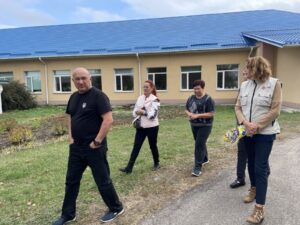
LAW’s Executive Director speaks with survivors of Russian occupation in Kyiv oblast
Russian forces have arbitrarily detained Ukrainians on a colossal scale since the beginning of the full-scale invasion. On 23 February 2026, we submitted a complaint to the United Nations Working Group on Arbitrary Detention on behalf of the families of ten Ukrainian civilians detained in the city of Enerhodar, which is home to the Zaporizhzhia Nuclear Power Plant – the largest of its kind in Europe.
Russia snatched civilians from the street, held them incommunicado, presented them with false criminal charges and tortured them in detention. The ten detainees whose families we represent are just a small number of the thousands unlawfully detained by Russian occupation forces.
In 2025, LAW also initiated the Global Tracking of Fugitives (GTF) initiative alongside our partner InterJust. Piloted in Ukraine, the initiative seeks to maximise the chances of apprehending suspects of atrocity crimes through cutting-edge open-source investigations supported with advocacy for better coordination. We profiled 45 suspects on atrocity crimes, monitored their movements in real time, and presented the GTF initiative to European prosecutors and law enforcement who will be the primary recipients of information.
Increased support to survivors
In Ukraine, LAW coordinates a women-led Consortium of organizations including JurFem, OPORA, and PROJECTOR that provide legal assistance and representation to Ukrainian victims and survivors throughout the country, particularly survivors of SGBV and CRSV. In 2025, we greatly expanded our work with survivor communities – we provided legal assistance to 703 people, and legal representation to 47 people. LAW and partners secured 19 favourable decisions in Ukrainian courts, including an in-absentia conviction of a Russian soldier for conflict-related sexual violence as a war crime.
“By supporting these cases, we both help victims and survivors and pursue our strategic goals. We want victim-centered approaches to become a natural part of how law enforcement and courts operate in Ukraine,” said Yulia Nikitina, JurFem’s legal assistance coordinator.

LAW supports trainings for female lawyers through its partner women-led legal organization JurFem, that is at the forefront of documenting gender-based crimes, including conflict-related sexual violence.
Capacity strengthening and mentoring
An essential part of LAW’s work in Ukraine is support for civil society organizations and local authorities, emphasizing underserved parts of the country. Alongside PROJECTOR, we began a series of training sessions for Ukrainian law enforcement and prosecutors on working with the LGBTQI+ community. Ukrainian LGBTQI+ civil society has documented persistent barriers such as misclassification of crimes, bias in investigations, and lack of informed procedural responses.
We trained 84 participants this year, improving Ukrainian authorities understanding of issues facing the LGBTQI+ community, and mainstreaming gender-sensitive approaches. In the long-term, we hope to see increased trust from traditionally marginalised communities and thereby meaningful access to justice.
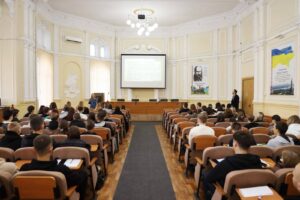
PROJECTOR and LAW deliver a training session in the Odesa police academy
Survivor-centred advocacy
Many times in 2025, high-level diplomatic peace negotiations between Ukraine and Russia overlooked justice completely. In November 2025, Ukrainian survivor-led groups and civil society organisations firmly rejected a leaked peace proposal that suggested blanket amnesties for international crimes. Through its advocacy, LAW ensures that Ukrainian survivor voices are heard at the most important fora around the world.
In December, 18-year-old Liza Dmitrieva travelled abroad for the first time to speak at LAW’s event organised on the side of the Assembly of State Parties of the International Criminal Court, in the Hague. She recounted her harrowing experiences of Russian occupation alongside children and young adults who lived through conflict and atrocity crimes in Myanmar, Sudan, and Palestine.
“Today, I’m standing here not to be pitied. I’m here to be heard, so you know what is happening to children in occupied territories right now,” said Liza Dmitrieva, who lived through Russian occupation as a child.

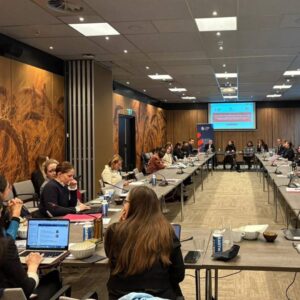
Liza Dmitrieva speaks at the side event at the Assembly of State Parties of the International Criminal Court
Today marks five years of Russia’s invasion. Civilians across Ukraine have been heavily affected by the war and its impact. Family members have been lost; infrastructure essential to answer daily needs has been damaged. And the situation is worsening. “Ukraine’s international partners must ensure that accountability is a top priority for 2026 and that the thousands of survivors who bear the cost of Russia’s aggression daily are not forgotten.” said Antonia Mulvey, LAW Founder and Executive Director.