
On the frontlines: the women leading the fight for justice and accountability
Gender Equality & GBV - Global - Advocacy - Legal Aid & Empowerment - Strategic Litigation
As we mark International Women’s Day, we honour the courage of women and girls across the world who continue to demand justice amid conflict, displacement, and systemic inequality. This year, the message is clear: justice for them is not optional – it is essential for peace, equality, and dignity. Moreover, as conflicts intensify in places where women and girls’ rights are already shrinking, accountability and protection is key not only for their future, but for their immediate survival.
Without confronting discriminatory laws, institutions, and norms, women’s rights cannot be fully realised. The question remains: what more can be done for women survivors and for the women who stand alongside them in places where justice often seems out of reach?
For Legal Action Worldwide (LAW), advancing gender justice and defending the rights of survivors of conflict-related sexual violence has always been central to its work. From strategic litigation to survivor-centred legal support, LAW ensures women are not excluded from justice processes but recognised as rights-holders with the power to demand accountability and drive legal change. Here is an overview of LAW’s work in some of the areas were women and girls are facing acute sexual and gender-based violence.
Strengthening gender justice in Ukraine
In Ukraine, conflict-related sexual violence – particularly against women and girls – has become a defining feature of Russia’s war. It is not incidental or opportunistic, but deliberate, systematic, and closely linked to the realities of military occupation, armed control, and arbitrary detention. In 2024, the Independent International Commission of Inquiry on Ukraine found that members of the occupying authorities of the Russian Federation committed rape and other forms of sexual violence against women and girls between the ages of 15 to 83 during house searches and in detention in Ukraine.
As of the end of January 2026, Ukrainian prosecutors have recorded almost 400 cases of conflict-related sexual violence, 248 of which involved women and girls. These crimes include rape, mutilation or violence against genital organs, forced nudity, threats and attempted rape, and forcing victims to witness sexual abuse inflicted on their loved ones.
Sexual violence has become a tool of terror, intimidation, social breakdown, and humiliation. While conflict-related sexual violence affects people of all genders, women and girls are disproportionately targeted in civilian settings. In 2025, LAW provided legal assistance to 548 women and supported 22 more legal cases for women in Ukraine.
At the same time, serious institutional barriers persist. Research conducted by Ukraine’s Office of the Prosecutor General shows that most respondents are unaware of reporting procedures or the assistance available to survivors of gender-based and conflict-related sexual violence.
In response, a significant part of LAW’s work in Ukraine focuses on supporting women-lawyers and streamlining approaches towards SGBV and CRSV. LAW works closely with JurFem, a women-led legal and human rights organisation that trains women lawyers, strengthens survivor-centred and trauma-informed legal practice.
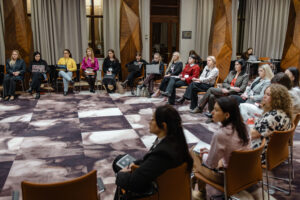
20 female lawyers from around Ukraine participate in JurFem Academy.
“Formal legal education still fails to adequately address SGBV, often stripping it of its gendered context and treating it as just another criminal offence,” – says Marta Pavlyshyn, lawyer and Program Manager at the JurFem Education Center.
LAW supports Female Human Rights Defenders Academy, where over the course of eight months, women-lawyers from across Ukraine strengthen their knowledge on issues of gender-based violence, conflict-related sexual violence, and survivor-oriented justice.
The international community must ensure that conflict-related sexual violence is investigated and prosecuted as a distinct and serious violation alongside other war crimes committed by the Russian Federation. Accountability for these crimes is essential to delivering justice for survivors.
Rohingya women at the World Court
In Myanmar, thousands of women’s lives were shattered by conflict and violence, yet many continue to lead the fight for justice and accountability. In the face of systematic abuses, from the 2017 clearances against the Rohingya to the increase in sexual and gender-based violence after the 2021 military coup, they have refused to be silenced.
Today, over 1.2 million Rohingya refugees live in camps in Cox’s Bazar; many of them endured widespread sexual and gender-based violence. Survivors continue to face deep trauma and stigma, compounded by patriarchal norms that often exclude women from decision-making within their communities.
Despite these barriers, Rohingya women have emerged as powerful advocates for accountability. Shanti Mohila (“Peace Women”), a network of Rohingya women’s collectives supported by LAW, provides legal awareness sessions within their communities and advocates for justice. In 2025, LAW trained 30 female survivor advocates from the network, who went on to lead 49 information sessions in the camps, reaching more than 6,000 women with information about legal rights and justice pathways.
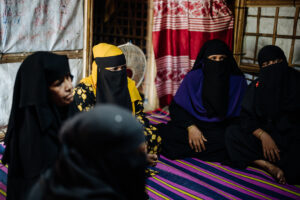
Shanti Mohila members conduct community information session in a shelter in the camps in Cox’s Bazar.
Their voices are increasingly reaching international justice forums. In January 2026, LAW facilitated the participation of three Shanti Mohila members at the full merits hearings in The Gambia v. Myanmar genocide case before the International Court of Justice in The Hague.
Within Myanmar itself, the situation has worsened since the 2021 military coup, with rising levels of CRSV targeting women, girls, LGBTQ+ individuals, and ethnic minorities. Survivors face barriers to medical care, psychosocial support, and justice amid ongoing conflict and displacement.
To date, LAW and its partners have documented 789 cases of SGBV and supported the creation of the Alliance Against CRSV–Myanmar, a coalition of 13 women-led organisations working to prevent and respond to CRSV. LAW has also trained 161 grassroots actors on international justice mechanisms and survivor-centred documentation, helping civil society record cases and advocate for accountability.
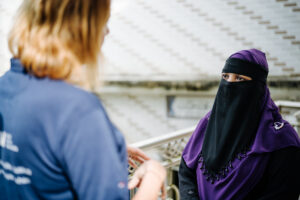
LAW’s Executive director Antonia Mulvey talks with Salma*, one of the Rohingya member of Shanti Mohila who traveled to the International Court of Justice to attend the full merits hearings on the genocide case The Gambia v. Myanmar.
Rohingya women survivors are already leading the fight for justice; global leaders and institutions must ensure their voices are heard. We call for the recognition, reparations, and accountability they deserve.
Sudanese women supporting the ICC
As Sudan enters its third year of devastating conflict, tens of thousands have been killed, displaced, or subjected to sexual violence and torture. Conflict-related sexual violence continues across Darfur, Gezira, and Khartoum.
Through its Access to Justice for Sudanese Survivors Project, LAW supports survivors in Adre refugee camp in Chad and beyond. Between December 2024 and December 2025, LAW reached over 500 women and girls with legal awareness sessions, provided individual legal consultations to more than 200 survivors, and facilitated nearly 480 referrals to psychosocial, medical, and safe housing services, including urgent medical care. At the same time, 50 survivor advocates were trained to act as first responders in refugee camps.
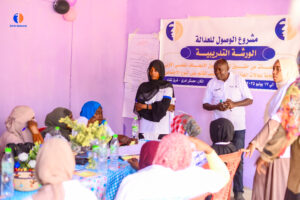
Participants during interactive group work as part of mentorship session held on 22 September 2025 in Adre refugee camp.
LAW’s work also extends to international accountability, with a legal brief submitted to the International Criminal Court on behalf of 22 Sudanese women, alongside statements delivered at the United Nations Human Rights Council to ensure survivors’ voices resonate globally. In partnership with civil society and the Wayamo Foundation, LAW is investigating international crimes and exploring universal jurisdiction cases, laying out the groundwork for future justice.
In Sudan, survivors are not only seeking justice; they are shaping it. Two of the women represented before the ICC have already been interviewed by the Prosecutor which a crucial early step toward accountability.
Historic milestone for the fight against CRSV in South Sudan
In South Sudan, LAW has been providing free legal aid through its Justice Confidence Centres in Wau and Malakal since 2022. Since their launch, the centres have handled hundreds of cases, including rape, gang rape, forced marriage, forced pregnancy, domestic violence, and arbitrary detention, representing both women and girls in court and mobile tribunals across Madan and Malakal. One landmark case secured the annulment of a forced marriage, allowing a survivor to return to school and pursue higher education – an example of how legal support can transform lives.
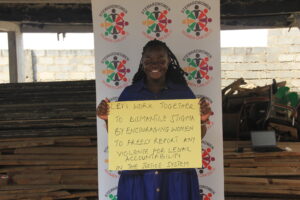
Alice Bogere from Steward Women during the #StigmaShouldNotStopAccountability campaign in Juba, South Sudan.
In July 2025, LAW achieved another historic milestone when the UN Committee on the Elimination of Discrimination against Women declared admissible a communication filed on behalf of 35 South Sudanese women survivors of CRSV. For the first time, a UN Treaty Body recognized the need to protect victims’ identities from the State.
Thousands of women and girls empowered through legal information in Somalia
Somalia’s protracted conflict, widespread displacement, and complex plural justice system create significant barriers to accountability for survivors of SGBV. Informal settlements often prioritise clan reconciliation over survivors’ rights, while stigma and fear discourage reporting.
LAW has worked in Somalia since 2013 and established a fully operational office in Mogadishu in 2020, providing survivor-centred legal support and working with communities. Since 2025, LAW has handled 71 SGBV cases, providing legal assistance to every survivor, filing 39 cases in court, and supporting others through investigation, documentation, or ongoing proceedings. Case types include domestic violence, rape, and sodomy, reflecting the breadth of challenges survivors face in the justice system.
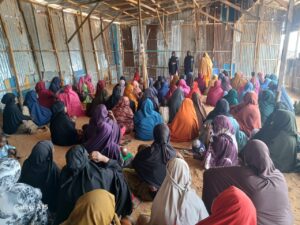
Participants during interactive legal training awareness session.
Community engagement is central to LAW’s approach. Through the Independent Complaint Mechanism (ICM), a network of trained female community leaders, survivors in IDP camps are identified and referred in real time. In 2025 alone, LAW led 39 legal information sessions that reached more than 5,200 people, including over 2,600 women and 1,300 girls, empowering communities with knowledge of legal rights and pathways to justice.
Beyond casework, LAW advocates for systemic change, engaging members of Somalia’s Federal Parliament on the draft Offenses of Rape and Indecency Bill to strengthen protections for survivors.