
Over 500 Days of Siege: Foreign Arms and the Rapid Support Forces’ (RSF) Campaign of Sexual and Genocidal Violence in El Fasher, Sudan
Accountability & Rule of Law - Child Victims of CRSV - Gender Equality & GBV - Sudan - Advocacy
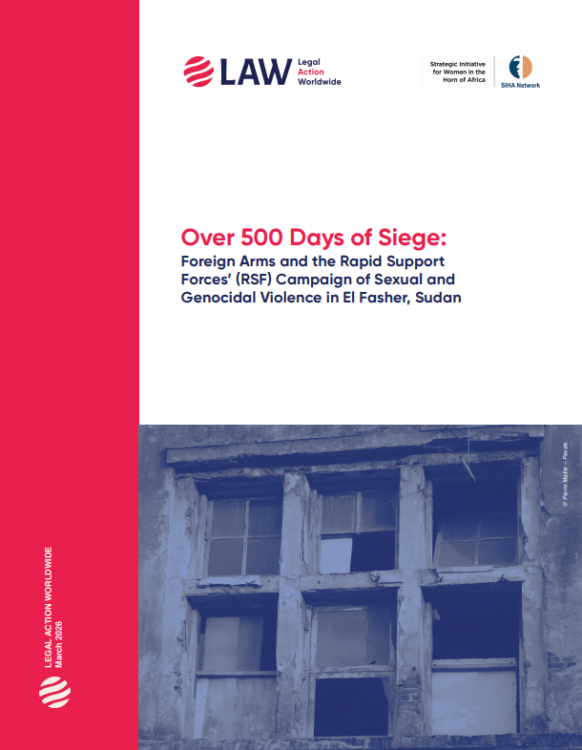
From late April 2024 until the city’s fall in October 2025, the people of El Fasher endured more than 500 days of siege. Today, Legal Action Worldwide (LAW) publishes its findings on how the Rapid Support Forces (RSF) and affiliated Arab militias used foreign-supplied weapons to encircle, starve, terrorise, and systematically target the Zaghawa, Fur, Berti, and Tunjur ethnic communities of North Darfur.
What our report documents
LAW’s legal, investigative, and military experts documented a pattern of conflict-related sexual violence (CRSV) that was as deliberate as it was devastating. Survivors described RSF and affiliated fighters breaking into homes, pulling women and girls from hiding places, separating men and boys from their families, and perpetrating rape in front of children and spouses. These acts were designed to destroy the bonds holding non-Arab communities together.
Women and girls were stopped at RSF checkpoints while trying to reach markets, fetch water, or collect firewood, then raped or sexually assaulted as punishment for moving without “permission,” or as a deliberate instrument of terror. Every major escape route, including toward Tawila, Kutum, Korma, and beyond, became a site of assault, abduction, and killing. Pregnant women were disproportionately targeted, with documented assaults resulting in miscarriages and long-term reproductive harm.
Throughout the capture of El Fasher in late October 2025, RSF fighters used explicit ethnic and racial language about ending non-Arab reproduction and “cleansing” neighbourhoods, echoing patterns already documented in West Darfur in 2023 and 2024. Many attacks were filmed and posted online by perpetrators themselves.
On the basis of this evidence, there are reasonable grounds to believe that these acts amounted to war crimes and crimes against humanity, and constituted a central component of a genocidal campaign against the Zaghawa, Fur, Berti, and Tunjur populations.
The role of foreign arms
Arms analysis carried out by LAW’s military and munitions experts found that the RSF’s capacity to encircle El Fasher, bombard civilian neighbourhoods, and tighten control over displacement routes was enabled by a continuous inflow of foreign-origin arms, ammunition, vehicles, and drones. There are reasonable grounds to believe that materiel originating in the United Arab Emirates (UAE) and China was routed through Chad and eastern Libya into the hands of RSF units, with shipments aligning with key escalations in the siege.
These transfers took place while UN bodies, humanitarian organisations, and independent experts were already publicly documenting RSF atrocities across Darfur. States that continued to arm or facilitate the movement of materiel to the RSF did so with the knowledge that their support carried a substantial risk of contributing to atrocity crimes.
Our call to action
This report is an urgent call to accountability. LAW calls on the RSF to immediately cease all attacks on civilians, permit full humanitarian access, and release all those held in conditions of sexualised captivity. We call on arms-supplying states — in particular the UAE — to immediately suspend all transfers, conduct transparent investigations into past transfers, and cooperate with all accountability mechanisms. We call on the UN Security Council to strengthen the arms embargo, impose targeted sanctions, and establish a civilian protection mission in Darfur. We call on the ICC to prioritise investigations into RSF conduct in El Fasher and North and West Darfur. And we call on humanitarian donors to scale up survivor services, support women-led organisations on the frontlines, and fund evidence preservation.
Survivors from Darfur and beyond have waited in vain for the promises of past peace processes to be honoured. We cannot undo what has been done in El Fasher. We can, however, ensure that the decisions which armed and enabled the RSF are named, investigated, and brought within the reach of the law — and that survivors of sexual violence are placed at the centre of how this conflict is understood and confronted.
LAW will continue to collect, preserve, and share evidence for future accountability proceedings, and to support survivors who choose to pursue justice.