
The Right to a Home: how one family is challenging the discriminatory laws that justify Israel’s demolition of Palestinian homes in East Jerusalem
Accountability & Rule of Law - Gender Equality & GBV - oPt/Israel - Advocacy - Legal Aid & Empowerment - Strategic Litigation
Following a complaint filed by Legal Action Worldwide (LAW) and partners, the UN Special Rapporteur on the Right to Adequate Housing found that the demolition of Abu Diab family home in February 2024 was illegal and sent a formal communication to Israel.
The communication, sent jointly by multiple Special Rapporteurs, notes that the demolition represents a broader and increasing pattern of unlawful home demolitions in East Jerusalem, alongside the establishment and expansion of Israeli settlements in the same area. The communication expresses concern that the demolitions of Palestinian homes are facilitated by discriminatory urban planning laws, which make it virtually impossible for Palestinians to obtain legal permits for their homes and prevent them from accessing legal remedies for housing matters before Israeli courts.
This is not an isolated incident. In the first four months of 2026, over 250 Palestinians have been displaced by administrative demolitions and evictions in East Jerusalem, 60 per cent of whom were in the Silwan area; these comprise roughly 180 people displaced by lack-of-permit demolitions and the rest due to evictions implemented by Israeli authorities pursuant to legal cases filed by Israeli settler organizations
You can read the communication from the Special Rapporteurs in full here.
The Abu Diab Family
Mr Fakhri and Mrs Amina Abu Diab are Palestinian community leaders and prominent human rights defenders. For over two decades, Fakhri Abu Diab has chaired the Bustan Residents’ Committee, serving as a spokesperson for residents of Silwan, affected by house demolitions, restrictive urban planning and displacement policies. Amina Abu Diab is actively involved with the Social Solidarity Organisation, a grassroots women’s group in Silwan dedicated to promoting social welfare, mutual support and community resilience amongst Palestinian women and families.
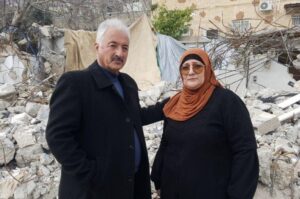
Fakhri and Amina Abu Diab stand in front of the remains of their home in Silwan (photo: Al Jazeera).
The Abu Diab’s home was built in the 1950s in the Al Bustan neighbourhood of Silwan, prior to the de facto annexation of East Jerusalem in 1967. Since 2010, the Abu Diab family has been targeted by Israeli legal proceedings seeking the demolition of their home. The Jerusalem Municipality seeks to build a ‘biblical theme park’ in the Al-Bustan area. Despite extensive legal efforts that highlighted how the Abu Diab’s faced discriminatory policies and practice, a demolition order was issued in 2024. Following the rejection of an appeal, the family were given minutes to leave before bulldozers destroyed the family home and belongings in February 2024.
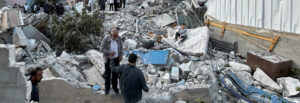
Mass demolitions of Palestinian homes in Al Bustan area of Silwan in 2024 (Photo: UN OCHA).
The demolition of the Abu Dhabi home and the legal struggles faced reflect a broader pattern: the demolition of Palestinian homes alongside the expansion of Israeli settlements in East Jerusalem. This is facilitated by laws and policies which are often implemented in a way that prevents Palestinians from obtaining legal permits, exposing them to the risk of forced evictions and demolitions without provision of alternative adequate housing. Further, demolitions enforced by Israeli authorities, carried out through judicial proceedings that fail to uphold fundamental guarantees of due process and fair trial, effectively deny Palestinians meaningful access to justice and render access to judicial remedies virtually impossible, leaving Palestinians without a practical avenue to contest demolition orders.
Gendered Impact
The complaint submitted to the Special Rapporteur underscored the gendered impact of Israeli policies. During home demolitions, women often face physical violence, excessive force, verbal abuse, and intimidation, creating fear and lasting trauma for entire families, especially children. After displacement, women’s independence is further reduced, while the pressures of managing household survival increase – often intensified by traditional expectations placed on Palestinian women. The loss of privacy, financial strain, and existing patriarchal conditions can also heighten the risk of domestic violence and deepen the emotional impact of the demolition. At the same time, there is a serious lack of safe shelters where Palestinian women can go with their families, leaving them with few or no secure options after their homes are destroyed, increasing their vulnerability.