
World Humanitarian Day – Justice for Aid Workers Under Attack
Accountability For Aid Workers - Global - Advocacy - Legal Aid & Empowerment
It has never been more dangerous to be an aid worker. According to the Aid Workers Security Database, 2024 was the deadliest year on record – and in 2025 the number of recorded aid workers fatalities fell by just 37 to 350.
Across conflicts, people delivering life-saving assistance have been increasingly targeted by warring parties – in violation of international humanitarian law and international human rights law. According to the UN Emergency Relief Coordinator Tom Fletcher, at least 326 humanitarian workers were killed across 21 countries in 2025, bringing the death toll over the past three years to more than 1,010. Behind those figures are countless others who have been injured, arbitrarily detained, abducted, or left with lasting psychological trauma simply for helping vulnerable communities accessing lifesaving assistance.
Recognising this dangerous trend, on September 21, 2025, over 100 States came together to issue The Declaration for the Protection of Humanitarian Personnel. Under the Declaration, 115 State signatories, to date, have committed to taking practical action to increase the protection of humanitarian personnel. LAW is an implementing partner of the core commitment to pursuing greater accountability and justice in response to incidents. The declaration came on the back of the Security Council Resolution 2730 adopted unanimously on 24 May 2024 – less than a month after the targeted strike by the Israeli military which killed seven humanitarian staff from World Central Kitchen in Gaza. The Security Council urged States to investigate and prosecute perpetrators of attacks on aid workers in accordance with their obligations under international law.
LAW is part of the Protect Aid Workers consortium, a rapid-response mechanism for aid workers and their immediate families who have suffered critical incidents such as injury, kidnapping, arrest and other violence.
“Aid workers are protected under international law. Deliberate and targeted attacks against them are crimes, and impunity breeds more violence. This is why we must systematically obtain justice for such crimes”, said Antonia Mulvey, Legal Action Worldwide’s (LAW) Executive Director. “Protecting aid workers and ensuring that attacks against them do not go unanswered is a big part of ourwork. We combine legal representation, advocacy and trainings to support aid workers victims of violence and their families.”
Legal Services to Aid Workers
Since the launch of the programme in 2025, LAW has provided legal services in cases concerning 147 aid workers killed, arbitrarily detained, tortured, and targeted by sexual violence. We represented them or their families before domestic courts, UN human rights mechanisms and national courts exercising universal jurisdiction. To date, LAW contributed to the release of 21 aid workers from arbitrary detention.
Among those we currently represent is Dr. Hussam Abu Safiya, a prominent Palestinian physician who remains in detention in Israel. We are working closely with his lawyer, Nasser Odeh, and engage in high-level public and closed-door advocacy to demand his immediate removal from solitary confinement, access to adequate medical care, and a prompt and fair judicial review of the legality of his detention. The Commission of Inquiry on the Occupied Palestinian Territories, the Office of the High Commissioner for Human Rights, the Working Group on Arbitrary Detention, as well as numerous UN Special Rapporteurs have equally called for the immediate release of Dr. Abu Safiya and for independent medical visits. LAW calls for the release of all Palestinian medical personnel from Israeli detention so that they can return to their communities and continue to save lives.
In November 2025, Tunisian humanitarianaid workers Mustapha Djemali and Abderrazek Krimi were released after spending 18 months in detention for providing humanitarian assistance to refugees through the Tunisian Council for Refugees. LAW represented their families throughout the legal proceedings and was present in Tunisia when the court ordered their release. While them and other aid workers arbitrarily detained in Tunisia were eventually released, Saadya Mosbah, a 66‑year‑old aid worker and human rights defender, who was sentenced in February 2026 to eight years’ imprisonment for her work supporting sub-Saharan refugees, remains detained in extremely difficult conditions.
“The support that we received – us and, crucially, our families – was the only source of comfort we had during our detention,” said Abderrazek Krimi upon his release.
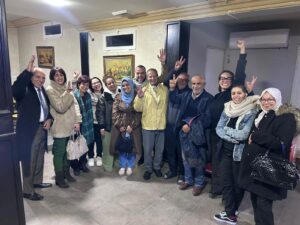
Mustapha Djemali, Abderrazek Krimi and their families upon release.
Our teams are also building a network of lawyers and investigators across several humanitarian contexts. The lawyers and investigators will be deployable to support aid workers in detention and aid workers and their families who wish to seek justice following an incident, to help humanitarian organisations to document incidents, and when appropriate, to provide expertise to domestic justice actors to conduct investigations and prosecutions.
Legal Information Sessions
Protecting aid workers is not and should not be only about responding after violations occur. It is also about ensuring they know their rights before they find themselves at risk.
To that end, LAW has provided legal information to over 120 aid workers from national and international organisations through information sessions held in Ukraine, Kenya, South Sudan, Jordan, Thailand and Lebanon. Participants explored international human rights law and international humanitarian law, arbitrary detention and fair trial rights, accountability mechanisms, and practical methods for documenting attacks and other violations.
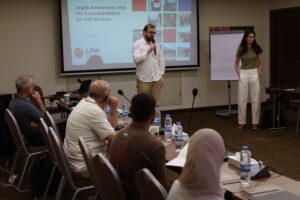
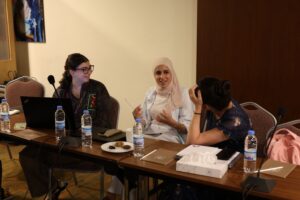
Legal information sessions for aid workers in Beirut, Lebanon, July 2026
The sessions are particularly important for national staff, who make up the overwhelming majority of victims of attacks against air workers. They are always the first on the frontlines and to come under attack. Aid Workers Security Database shows that out of 350 aid workers killed worldwide in 2025, staggering 349 were national staff.
In Ukraine, this is an incredibly difficult reality. While evacuating civilians from frontline areas, delivering humanitarian aid, or providing medical care through mobile teams, aid workers put themselves in harm’s way. As drones and explosive weapons are now spreading death and fear far beyond the battlefield, aid workers also face more risks of targeted attacks.
“That should never become an accepted cost of war. Humanitarian personnel have been killed while carrying out humanitarian missions in Ukraine. They deserve thorough and impartial investigations into their deaths, and their families deserve justice and reparations.” – Natela Shevchenko, Kharkiv Regional Organization of the Ukrainian Red Cross Society.
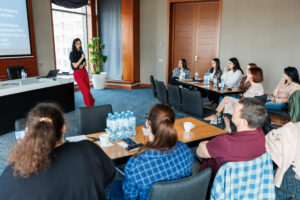
Legal information session in Kyiv, Ukraine, April 2026.
International Fora
Beyond legal information, assistance and representation, LAW works with partners, humanitarian organisations and affected aid workers to change the systems that too often allow attacks against aid workers to go unanswered, and to bring these issues to the highest international fora.
Over the past year, LAW has organised and contributed to high-level discussions at the UN Commission on the Status of Women in New York, Protection of Civilians Week, and the UN Human Rights Council in Geneva, advocating for stronger protection of humanitarian personnel and greater accountability for violations against them.
“Through legal action, information and international advocacy, LAW is working to ensure that humanitarian workers are not only protected while carrying out their life-saving work, but that when they are attacked, those responsible are held to account”, said Camille Delbourgo, Programme Manager at LAW.
As we mark World Humanitarian Day, we call on states and the international community to turn commitments into action and ensure that attacks on humanitarian personnel never go unanswered.