
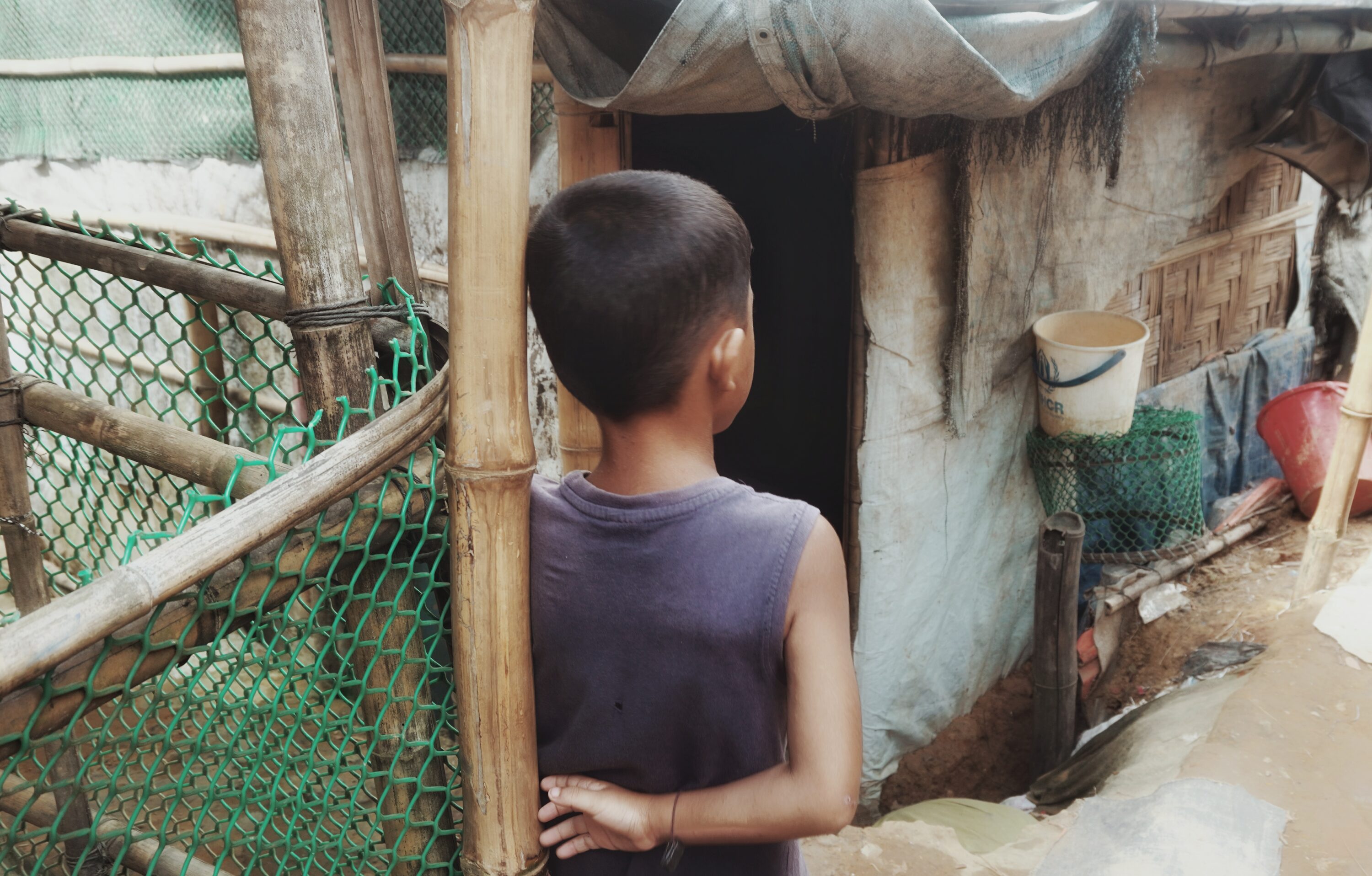
Justice for Child Victims
Legal Action Worldwide (LAW) works alongside child victims and survivors to pursue accountability, strengthen child-centred justice systems, and ensure that children’s experiences, rights, and voices are recognised within national and international responses to conflict and mass atrocities.
Children living through conflict experience devastating and life-changing harms. Across conflict-affected contexts, children are subjected to killings, torture, arbitrary detention, sexual violence, forced displacement, recruitment by armed groups, family separation, and other grave violations. Many are denied safety, education, healthcare, and the support needed to recover and rebuild their lives.
For children who survive violence and abuse, the impacts can last long after conflict ends – affecting their physical and mental health, relationships, livelihoods, education, and ability to participate fully in society.
Yet children’s experiences are too often overlooked within justice and accountability processes.
A major focus of LAW’s work is strengthening access to justice for child victims of conflict-related sexual violence (CRSV), particularly boys and Lesbian, Gay, Bisexual, Transgender, Queer and Intersex (LGBTQI+) youth, whose experiences remain especially under-recognised and underreported.
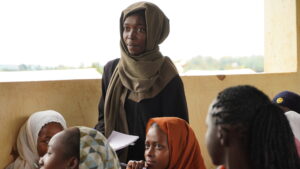
Yousra, a Sudanese refugee girl participates in one of LAW’s trainings at the Kiryandongo Refugee Settlement in Uganda
Introduction
Children continue to bear the devastating consequences of armed conflict. In recent years, the number of grave violations committed against children in conflict has reached unprecedented levels. Children are being killed, displaced, detained, recruited by armed groups, separated from their families, and subjected to widespread sexual violence in conflicts across Gaza and the occupied Palestinian territory, Sudan, Ukraine, Myanmar, the Democratic Republic of the Congo, Somalia, and elsewhere.
CRSV against children continues to be significantly underreported owing to stigma, fear of reprisals, harmful social norms, lack of access to services, insecurity, and impunity. For many survivors – particularly boys and Lesbian, Gay, Bisexual, Transgender, Queer and Intersex (LGBTQI+) youth – justice systems remain inaccessible or unsafe.
Despite growing recognition of these harms, accountability processes have historically failed to adequately address crimes against children or meaningfully include children within justice processes. Violence against boys and LGBTQI+ youth in particular has remained under-recognised and under-prosecuted.
At the same time, important progress has begun to emerge within international justice systems. In 2023, the International Criminal Court (ICC) issued an arrest warrant against Russian President Vladimir Putin for the deportation of Ukrainian children and adopted a renewed Policy on Children recognising children’s rights to participate in justice processes affecting them. LAW contributed to the development of the Policy as an expert consultant, helping to strengthen child-centred and participatory approaches within international investigations and accountability mechanisms.
Across the international justice field, there is also increasing recognition of the need for child-sensitive, trauma-informed, and survivor-centred approaches to documenting and prosecuting atrocity crimes.
LAW works to help turn these commitments into meaningful access to justice for children and young people affected by conflict worldwide.
Our Approach
LAW’s work is grounded in the principle that child victims and survivors should define what justice means for them. We work in partnership with children, youth-led organisations, grassroots groups, and local practitioners to pursue accountability that is survivor-centred, child-sensitive, and inclusive.
Our programme is built around three interconnected pillars:
1. Increasing Access to Justice for Child Victims
LAW supports child victims of conflict-related sexual violence to access justice processes in conflict-affected contexts globally, including:
- Syria
- Lebanon
- Occupied Palestine
- Sudan
- South Sudan
- Somalia
- Uganda
- Ethiopia
- Bangladesh
- Sri Lanka
- Myanmar
- Ukraine
We pursue precedent-setting litigation and high-impact legal outcomes to strengthen recognition of child victims and survivors within national, regional, and international justice systems.
Our work includes:
- Strategic litigation and legal representation
- Support to investigations and accountability mechanisms
- Documentation and evidence gathering
- Survivor-centred legal advocacy
- Child-sensitive legal analysis
- Support for reparations and official recognition
LAW also works to strengthen access to justice for underrepresented survivors, including boys and LGBTQI+ youth, whose experiences have historically been excluded from accountability processes.
Impact in Practice
Legal Support Across Multiple Contexts
In 2025, LAW provided legal information and representation to 1,943 child victims in Somalia, South Sudan, the Rohingya refugee context, Sri Lanka, Lebanon, and Syria, including 767 boys.
Occupied Palestinian Territory
LAW works closely with Palestinian, Israeli, and international lawyers to identify creative pathways for accountability. LAW supported the filing of a groundbreaking universal jurisdiction case concerning 21 children killed by state actors.
Rohingya Children and Genocide
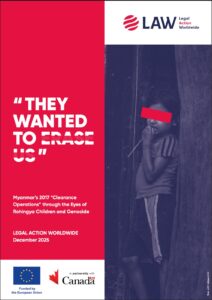 LAW’s groundbreaking report, “ THEY WANTED TO ERASE US” Myanmar’s 2017 “Clearance Operations” through the Eyes of Rohingya Children and Genocide, examines how Myanmar’s 2017 military clearance operations specifically affected Rohingya children and explores the long-term psychological and social impacts of genocide on child survivors.
The report contributes to ongoing international accountability efforts by advancing child-rights and child-competent approaches to documenting atrocity crimes.
Somalia
Through legal aid clinics operating in internally displaced persons (IDP) camps in Mogadishu, LAW has supported child survivors of rape and sexual violence with legal representation, referrals to medical care, and psychosocial support.
Alongside direct legal services, LAW conducts regular legal information sessions for children and families in displacement settings.
South Sudan
LAW’s Justice Confidence Centres in Wau and Malakal provide legal aid to child survivors of rape, gang rape, and forced marriage.
In 2025, the UN Committee on the Elimination of Discrimination Against Women (CEDAW) admitted a landmark communication submitted by LAW against the Republic of South Sudan on behalf of survivors of conflict-related sexual violence, including children.
The Committee recognized that survivors lacked access to effective domestic remedies and affirmed the responsibility of South Sudan for the sexual and gender-based violence suffered by survivors.
Sudan
LAW has supported child survivors displaced by conflict in Sudan with legal advice on their rights, including access to reporting mechanisms, medical care, and psychosocial support.
Syria
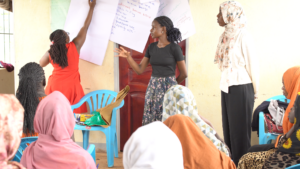
Through mobile justice units operating in Idlib and Aleppo governorates, LAW identified child victims subjected to arbitrary detention, torture, and sexual violence while detained by the Assad regime.
Following the fall of the Assad government, LAW is supporting survivors seeking justice through emerging national transitional justice processes.
2. Setting Standards and Building a Community of Practice
Ending sexual violence and abuse against children in conflict requires coordinated action across national, regional, and international justice systems.
LAW works to strengthen child-sensitive approaches to justice by convening practitioners, developing technical resources, and supporting collaboration across accountability ecosystems.
Child Victim Response Database
LAW created the Child Victim Response Database – an online tool designed to make best practices in responding to child victims more accessible to practitioners.
The database collates guidance and resources from more than 65 national, regional, and international justice mechanisms, alongside materials developed by United Nations agencies, governments, and civil society organisations.
Developed through extensive global research, the database supports practitioners working on:
- Documentation of crimes against children
- Child-sensitive investigations
- Interviewing and evidence collection
- Survivor participation in justice processes
- Accountability for sexual violence against children
The Child Victim Response Database launched on World Children’s Day in November 2024 and represents a major contribution to strengthening practitioner knowledge and coordination globally.
Building Better Practice
LAW convenes experts, practitioners, grassroots organisations, and survivors to strengthen collaboration and develop better responses to child victims of sexual violence and abuse.
This includes:
- Technical workshops and roundtables
- Development of best practice resources
- Promotion of child-centred investigative approaches
- Expansion of jurisprudence and legal analysis on child victims
- Defining gender-competent approaches inclusive of LGBTQI+ youth
LAW is also working to establish an annual expert convening dedicated to monitoring trends and strengthening justice responses for child and LGBTQI+ victims of conflict-related sexual violence.
3. Strengthening Grassroots Expertise and Youth Leadership
Children, youth organisations, and grassroots civil society actors play a critical role in increasing access to justice and challenging the silence surrounding sexual violence.
LAW supports organisations led by and working closely with children, youth, and LGBTQI+ communities to strengthen survivor advocacy, awareness raising, and participation in justice processes.
Our support includes:
- Small grants for grassroots initiatives
- Leadership and advocacy training
- Safe spaces for youth and survivors
- Support for youth councils and survivor-led platforms
- Capacity strengthening for community organisations
Youth Advocacy in South Sudan
In January 2025, LAW and Living Hope Foundation organised the Children and Young People’s Parliament in Wau, South Sudan.
The event brought together children, youth leaders, judiciary representatives, police, and government officials to discuss conflict-related sexual violence and barriers to justice.
Young participants advocated directly before the Council of Ministers for:
- Safer reporting mechanisms for survivors
- Stronger accountability within security forces
- Improved support systems for child victims
The event was broadcast nationally, amplifying youth voices and promoting survivor-led advocacy.
Safe Space for LGBTQI+ Youth in Ukraine
With support from LAW, partner organisation PROJECTOR established a safe space for LGBTQI+ youth and allies in Odesa, Ukraine.
The initiative provides confidential psycho-emotional support, legal awareness sessions, and professional training on protection against stigma, discrimination, and sexual violence in the context of conflict and martial law.
The space continues to serve as an important hub for solidarity, resilience, and rights advocacy.