
Afghanistan
Background
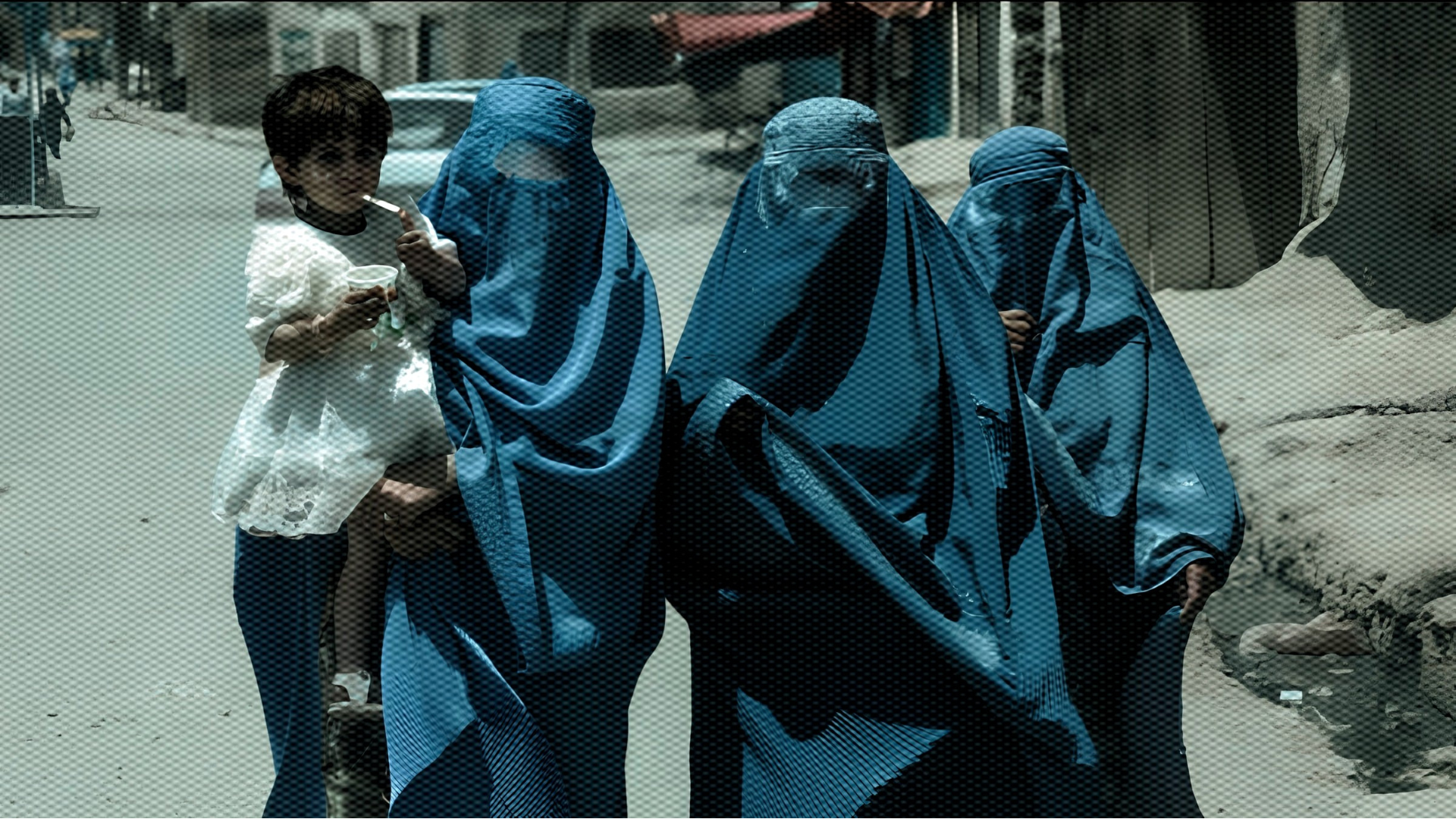
Since the Taliban’s return to power in 2021, Afghanistan has been engulfed by pervasive and systematic patterns of human rights violations and international crimes. Civilians continue to face arbitrary arrest and detention, torture and sexual violence, enforced disappearances, extrajudicial executions, and a regime of gender persecution, characterized by severe, widespread violations of the rights of women and girls.
More than 100 decrees designed to erase women and girls from public life have restricted their access to education, employment, movement, justice and participation in society. The August 2024 “Law on the Promotion of Virtue and Prevention of Vice” (PVPV) restricted women’s movement without a mahram, mandated full body covering, and prohibited women’s voices being heard in public. Raids and threats have driven female NGO staff from their jobs, crippling essential services.
The Taliban have completely transformed the Republic-era legal system and judiciary and dismantled the specialised legal frameworks and institutions relating to women’s rights. The Taliban’s January 2026 Decree No. 12 on the Criminal Procedure Code for Courts has further dismantled remaining judicial protections, deepening impunity and leaving victims and survivors with limited avenues for redress inside Afghanistan.
The current accountability ecosystem for Afghanistan spans several important but still developing avenues, including arrest warrants issued by Pre-Trial Chamber II of the International Criminal Court against the Taliban’s Supreme Leader and Chief Justice for gender persecution as a crime against humanity, the CEDAW initiative that could result in proceedings before the International Court of Justice, the newly established Independent Investigative Mechanism for Afghanistan, and people-centred initiatives such as the People’s Tribunal for Women in Afghanistan.
Though Afghanistan’s women and girls are in sharp international focus, yet there is limited access to justice and accountability for what occurred in the past and is ongoing. A robust framework of meaningful, long-term accountability is needed to break this cycle of impunity and restore a measure of dignity to victims and survivors.
LAW in Afghanistan
LAW is working with Afghan and international civil society, including in collaboration with APRRN, to protect the rights of women and girls, with a particular focus on survivors of gender-based violence in Afghanistan.
Drawing on our deep operational experience across the global accountability ecosystem, including the International Criminal Court, the International Court of Justice and national litigation under universal jurisdiction, LAW with its women-led partners aim to lay the foundation for long-term accountability mechanisms that empower Afghan victims and survivors. This includes supporting co-development of concrete legal strategies; strengthening coordinated engagement with UN mechanisms and Member States; and advancing accountability pathways amid growing normalisation of the status quo and a worsening situation on the ground.
HIGHLIGHTS
Informing the Survivor-Centred Design of the IIM-A
LAW has contributed across key consultative processes undertaken thus far, for the survivor-centred design and operationalisation of the Independent Investigative Mechanism for Afghanistan (IIM-A).
Drawing on direct experience collaborating with the IIIM for Syria and the Independent Investigative Mechanism for Myanmar (IIMM), LAW has provided insights and lessons learnt on a series of practical points covering mandate implementation, evidentiary strategy, engagement with civil society, and information sharing. The aim is to support the development of the Mechanism so that it can be technically credible, its information usable by courts/ judicial fora, and capable of sustained cooperation with a wide range of actors, including Afghan civil society, under challenging conditions.
62nd Human Rights Council
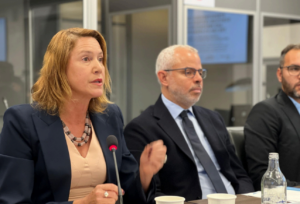
On 18 June, LAW Founder and Executive Director Antonia Mulvey spoke at a side event co-hosted by the Islamic Republic of Afghanistan Mission to the United Nations in Geneva and Austria, entitled “Strengthening Coordination, Survivor-Centred Accountability, and Prevention in Light of the IIM-A’s Operationalisation.” Ms Mulvey highlighted the role of the frontline legal organizations for the newly established IIM-A to succeed.
“I believe that if civil society frontline organisations work with victims and survivors and UN mechanisms and Member States, we can achieve successes even in a world where today, let’s be clear, international law is being violated daily.”
Upcoming
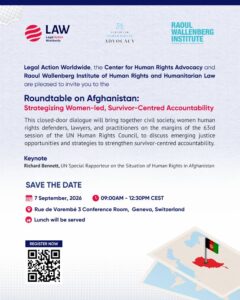 📢⚖️Join us alongside Center for Human Rights Advocacy and the Raoul Wallenberg Institute for the 𝗥𝗼𝘂𝗻𝗱𝘁𝗮𝗯𝗹𝗲 𝗼𝗻 𝗔𝗳𝗴𝗵𝗮𝗻𝗶𝘀𝘁𝗮𝗻: 𝗦𝘁𝗿𝗮𝘁𝗲𝗴𝗶𝘇𝗶𝗻𝗴 𝗪𝗼𝗺𝗲𝗻-𝗹𝗲𝗱, 𝗦𝘂𝗿𝘃𝗶𝘃𝗼𝗿-𝗖𝗲𝗻𝘁𝗿𝗲𝗱 𝗔𝗰𝗰𝗼𝘂𝗻𝘁𝗮𝗯𝗶𝗹𝗶𝘁𝘆.
Five years after the military takeover of Afghanistan, as the situation for Afghanistan’s women and girls continues to worsen, this half-day roundtable will convene Afghanistan’s leading women human rights defenders, lawyers, and practitioners to share their visions of justice and accountability, move the accountability discourse forward through the co-development of concrete strategies, and strengthen coordinated efforts.
We are honoured to have Mr. Richard Bennett, United Nations Special Rapporteur on the situation of human rights in Afghanistan, deliver the keynote.
📅 7 September 2026
🕘 9:00 AM – 12:30 PM CEST
📍 Rue de Varembé 3 Conference Room, Genève
🔗 Register Here: https://lnkd.in/gVhWprBQ
#Afghanistan #Women #Accountability #StrategicLitigation