
Register of Damages: The foundation of future compensations for Ukrainians
Accountability & Rule of Law - Ukraine - Legal Aid & Empowerment
Imagine losing everything overnight. Your home, your job, your loved ones, your properties, your business. This is the reality of millions of Ukrainians suffering from the consequences of the Russian aggression. Proper documentation and collection of evidence of the impact of war are key to support future claims for reparation and compensation. This is precisely why the Register of Damages for Ukraine (RD4U) was established.
The Register is an international mechanism introduced to collect and record claims for damage caused by Russia’s aggression in Ukraine. Individuals can submit claims for forced displacement, personal injury, sexual violence, the death of loved ones, loss of property, and other consequences of the war. In total, the Registry is expected to include 43 categories of claims, which are being introduced gradually. Several categories have also been opened to document the systemic economic losses suffered by Ukrainian businesses and the State.
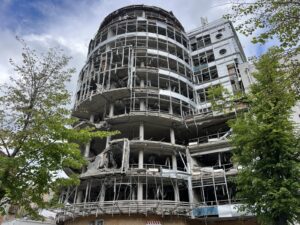
A building destroyed by a Russian missile strike on Kharkiv, Ukraine. Photo: Yuliia Homonets/Legal Action Worldwide
RD4U serves as the foundation of a future international compensation and reparations system. History shows that obtaining war reparations is a deliberate, step-by-step legal process. For example, The UN Compensation Commission secured $52.4 billion in payments from Iraq to Kuwait. And Germany completed payments related to its World War I obligations only in 2010.
In both cases, the decisive factor was not political statements, but properly documented facts and evidence collected at the earliest stages.
In Ukraine and Poland, LAW supports OPORA, a non-governmental organisation that helps people submitting their claims for free: offline in frontline cities in Ukraine and in Warsaw, as well as online.
“Most internally displaced people don’t have a computer or a laptop, and you can’t submit an application through Diia [Ukraine’s government digital services platform] on your phone. I often help older people who only have a basic mobile phone and don’t even have a banking app, so we end up completing the whole process on our laptop for them.” – shared Vadym Holovchenko, OPORA’s consultant in Dnipro.
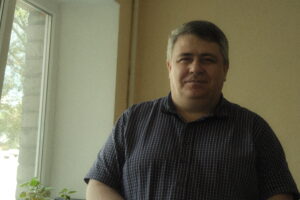
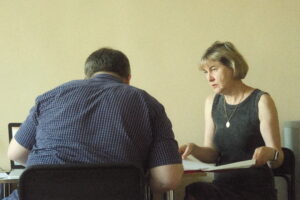
Vadym, an active community leader, provides one-on-one consultations to people who want to submit a claim to the Register in Dnipro.
People often require multiple consultations. Few bring all the necessary documents on their first visit, including proof of property ownership, photographs of the damage, and other supporting documentation. As new claim categories open, many return to submit additional claims to the Register.
“I’m not sure I would have been able to submit it on my own. You need all sorts of documents and certificates. Even now, I still don’t feel like a local here – I don’t know where to go or who to turn to. At first, we only applied under one category, as internally displaced people, because we didn’t know we were eligible to apply under others as well. Vadym explained which supporting documents we needed, because no one is simply going to take our word for it.” – says Liudmyla, internally displaced and a RD4U claimant.
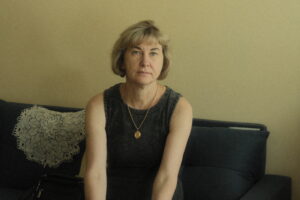
Liudmyla came to the consultation to submit her claim to the Register of Damages for Ukraine.
Liudmyla and her husband spent their lifetime building their home in Chaplyne [village in Dnipro region, south-east Ukraine]. They lived there for thirty years and planned to stay there forever, to grow old there
“We left in November 2022, when it was no longer possible to stay. We’ve been living in Dnipro ever since. We lost our home; active fighting is taking place there now. No one we know lives there anymore. A neighbour recently went back, and I asked her to take photos and videos of the house. Everything is destroyed. Everything has been looted.” – says Liudmyla.
Their claims went beyond forced internal displacement and covered the loss of property, loss of a home, property damage, and material losses.
The Register’s official records make it impossible to deny or downplay the scale of Russia’s aggression in the future. Facts properly documented today will become the legal foundation for future decisions by international courts and institutions.
It is important to note that the Register does not assess the merits or value of claims, nor does it determine or award compensation. Its role is to collect and record information as a first step towards a future international compensation mechanism. Once established, this mechanism will assess claims and determine compensation, with the claims and evidence collected by the Register transferred to it.
Every submitted claim to the Register of Damages for Ukraine becomes an officially confirmed fact and an integral part of the international body of evidence that will support future compensation proceedings.
If you or someone you know need help filing a claim to the Register, OPORA’s consultants provide assistance:
In person: Warsaw, Dnipro, Lviv, Mykolaiv, Rivne, Odesa, Chernihiv
Online: oporaua.org/zbitku