
Children Harmed by Aggression Must Have a Voice in Justice
Child Victims of CRSV - Transformative Justice - Global - Advocacy - Legal Aid & Empowerment - Strategic Litigation - Technical Assistance
4 June 2026
On the International Day of Innocent Children Victims of Aggression, the world must confront a reality that is well-documented yet still not prevented: children remain among the clearest victims of war, aggression, atrocity crimes and displacement.
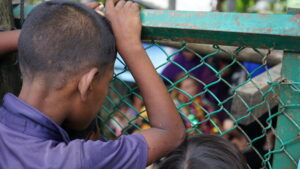
A refugee child looks through a fence in the camps in Cox’s Bazar, Bangladesh. (Photo: DUST/LAW)
The latest annual report of the United Nations Secretary-General on children and armed conflict, covering 2024, recorded an unprecedented level of violence against children. The UN verified 41,370 grave violations against children, affecting 22,495 children, a 25 per cent increase compared with 2023. Verified cases of sexual violence against children also rose by 35 per cent, even as such crimes remain significantly underreported because of stigma, fear of reprisals, lack of services, impunity and safety concerns. The same report makes clear that the verified figures do not capture the full scale of harm, given insecurity, access restrictions, underreporting and reduced child protection capacity.
These figures are not abstract. In Gaza, UNICEF has reported catastrophic levels of child deaths and injuries since October 2023. In Lebanon, children have continued to be killed, injured and displaced despite ceasefire announcements. In Iran, UN experts called for an investigation after reports that a girls’ school in Minab was struck, killing more than 160 children. In Sudan, UNICEF has warned that five million children in Darfur are facing extreme deprivation amid escalating violence and hunger, with more than 1,300 children reportedly killed or maimed in El Fasher since April 2024 alone.
The pattern is clear: children are being harmed in ways international law is meant to prevent and punish. Across conflicts, children are being killed and injured, forced from their homes, separated from their families, denied education and humanitarian aid, detained, recruited and used by armed actors, abducted, subjected to sexual violence, and attacked in places where they should be protected, including schools and hospitals.
This is both a protection crisis and a justice crisis.
Children harmed by aggression should not be defined only by the violations committed against them. They are rights-holders, and their safety, dignity, participation, recovery, reparations and futures must shape the pursuit of justice.
Justice systems Too often fail to recognise the specific ways children experience harm. They may overlook the loss of education, family separation, displacement, stigma, fear of authorities, loss of identity documents, or the impact of being asked to recount painful experiences without adequate protection or support. When these experiences are not properly understood,
Investigations may miss important evidence, accountability efforts may fail to capture the full extent of the harm caused and remedies may not address children’s actual needs. A child-sensitive, trauma-informed and survivor-centred approach is therefore not optional. It is what is required to deliver justice.
What LAW is doing
Legal Action Worldwide works to ensure that children harmed by conflict, aggression, atrocity crimes and displacement can access legal information, support, representation, participation, remedies and justice.
In 2025, LAW provided legal information and representation to 1,943 child victims across Somalia, South Sudan, the Rohingya refugee context, Sri Lanka, Lebanon and Syria, including 767 boys. Those figures represent children and young people whose experiences are not peripheral to accountability. They are central to understanding the full impact of conflict and mass atrocity.
LAW’s approach is grounded in a clear principle: children should not have to adapt to justice systems that were not designed for them. Justice systems must adapt to children, so they can be safely heard, properly supported, and meaninfully participate in processes that affect them.
Strengthening tools, policies and practice
LAW works to strengthen the standards, tools and practices that shape how justice systems respond to child victims.
LAW’s Child Victim Response Database brings together guidance and resources from more than 65 national, regional and international justice mechanisms, as well as materials developed by UN agencies, governments and civil society organisations. It supports practitioners working on child-sensitive documentation, investigations, interviewing, evidence collection, survivor participation and accountability for crimes against children.
This work reflects a simple reality: justice systmes are often designed around adultexperiences and assumptions. Without appropriate safeguards, justice processes can unintentionally cause further harm to children to fail to capture the full extent of the violations they have suffered. Children require procedures,support and participation mechanisms that recognise their agency while responding to their specific needs and capacities.
LAW also contributed as an expert consultant to the International Criminal Court Office of the Prosecutor’s renewed Policy on Children, launched in 2023. The Policy affirms children’s rights to participate in justice processes that affect them and supports stronger child-centred approaches within international investigations and accountability mechanisms.
The measure of these tools and policies is better practice. A child-sensitive justice system is not defined by what it says about children, but by whether children can safely access justice processes, participate meaningfully in them, and obtain appropriate protection, support, and remedies.
Somalia: legal aid and support for child survivors
In Somalia, LAW’s legal aid clinics in internally displaced persons camps have supported child survivors with legal representation, referrals to care and psychosocial support, alongside legal information for children and families.
For children and families living in displacement, legal support can be the difference between isolation and access to help. It can mean knowing where to report, understanding what rights and options exist, and being connected to services in a way that reduces harm rather than adding to it.
South Sudan: safer reporting and stronger justice engagement
LAW’s Justice Confidence Centres in South Sudan provide legal aid to child survivors. LAW has also supported youth advocacy spaces where children and young people can engage directly with justice, police and government actors on safer reporting and better support.
These spaces matter because children are not only sources of evidence. They are members of affected communities with views on what safety means, what barriers they face, and what justice systems need to change.
Rohingya refugee context: documenting atrocity crimes through a child-rights lens
In the Rohingya refugee context, LAW’s work has helped advance child-rights and child-competent approaches to documenting atrocity crimes, including research on the long-term impact of genocide on Rohingya children.
Children’s experiences are legally significant as well as personally devastating. When children are targeted, displaced, silenced or denied the conditions needed to learn and belong, accountability mechanisms must recognise the depth and distinct nature of that harm.
Sri Lanka, Lebanon and Syria: legal information and representation
LAW has also provided legal information and representation to child victims in Sri Lanka, Lebanon and Syria. In contexts marked by conflict, displacement and accountability gaps, access to legal information can help children and families understand their rights, available pathways and possible remedies.
Where children are affected by violence, justice cannot depend only on formal proceedings years later. It must also include practical, safe and accessible support at the community level, including information, referrals, representation and survivor-centred guidance.
Ukraine: protection, legal awareness and safe spaces
In Ukraine, LAW has supported a safe space for LGBTQI+ youth and allies in Odesa, providing confidential psycho-emotional support, legal awareness and protection against stigma and discrimination.
For LGBTQI+ children and young people, the impact of conflict can be compounded by exclusion, discrimination and barriers to services. Safe, confidential and rights-based support is therefore part of justice. It helps ensure that protection, information and support are accessible without discrimination.
Conclusion
On 4 June, remembrance is not enough. The International Day of Innocent Children Victims of Aggression should serve as a reminder that violations against children continuebecause they too often go unaddressed and unpunished.
Governments, justice institutions, UN mechanisms, prosecutors, investigators and donors must treat children harmed by aggression as rights-holders and survivors whose experiences are central to justice. Crimes against children must be properly documented, investigated and prosecuted. Children must have access to protection, legal support, and safe, voluntary and meaningful participation. Reparations and recovery must be shaped by children’s needs, and those responsible for violations must be held to account.
Justice cannot restore every childhood damaged by conflict. But it can determine whether that harm is recognised, recorded and answered. For child victims of aggression, justice must mean accountability, participation and reparation, and a refusal to treat violations against children as inevitable.