
“First They Called Me Foreigner. Then I Was Forced to Flee.”
Accountability & Rule of Law - Child Victims of CRSV - Rohingya Crisis - Advocacy
By Samir Sadaf*, a 23-year-old Rohingya youth from Saliprang village in Rakhine State, Myanmar, now living in the refugee camps in Cox’s Bazar. This testimony was collected by Legal Action Worldwide (LAW), a legal frontline organisation representing hundreds of Rohingya victims and survivors, ensuring they can get justice, including at the International Court of Justice. Samir also took part in LAW’s latest research on the lasting impact of Genocide on Rohingya children.
The first time I remember being told I did not belong, I was still a child at school, in Myanmar.
Students from other communities called me the “son of Kala,” a derogatory term used against Rohingya to mean foreigner. I did not understand it then, so I went home and asked my parents. They told me we were being called outsiders. I was born there. I was raised there. Myanmar was my homeland. But as a child, I was already learning that some people from the place I called home did not fully accept me.
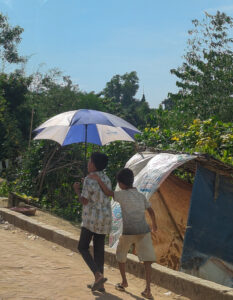
Two Rohingya children walk through the refugee camps in Cox’s Bazar, Bangladesh. (Picture: Akhyear/LAW)
Before 2017, my childhood still had peace in it. I went to school, spent time with friends, rode my bicycle around the neighbourhood, and returned to a home surrounded by trees. I remember the breeze in our compound. My family protected me. My teachers cared for me. School felt safe.
I wanted to become highly educated and help my community. I dreamed of becoming a politician or a community leader. Not for power, but to change what Rohingya people faced. At school, we were called foreigners. At checkpoints, we were stopped, separated, and checked. These things made me feel inferior. But they also shaped my ambitions. I wanted my people to live with respect.
Then came 2017. It was the eve of Eid al-Adha
Before my own family was forced to flee, people from other villages arrived in ours with their belongings. I asked my parents why they had left their homes. They replied that something terrible was happening, and it made me fear that we would have to leave too. Around midnight, we heard gunfire from our house. The sound grew louder and louder through the night. We could not sleep. By dawn, military forces had entered villages in our area. People were fleeing in fear. Bullets were fired at fleeing crowds. Some died on the spot. Some could escape. Soon, my family also fled.
I did not know where we were going. I only knew we were trying to escape the bullets and the sound of shooting. We could not take food or belongings. We left without knowing whether we would ever return, or whether I would see my friends and teachers again. I also left behind a pet bird that followed me everywhere. Even when I went to school, it sat on my school bag or shoulder. I wanted to take it, but I did not dare tell my family. We were running from danger. There was no time for a child to ask for one more thing. It was not the largest loss, but when a child flees, even the smallest parts of childhood are left behind.
We walked for three or four days toward Bangladesh. We had no food. It rained throughout the journey. We crossed Rohingya villages that were burning. I saw death and panic on the way. I saw things no child should have to see. I remember following my family, not because I understood everything, but because staying behind was impossible.
When we finally arrived at the Naf River, several families, including some of our relatives, got into a traditional paddle boat. Another boat full of people was near ours. I saw it sink. I remember the shock and the fear that the same thing might happen to us. Luckily, we reached Bangladesh exhausted, with nothing except the clothes we were wearing. People gave us water and snacks. We had escaped with our lives, but we did not know how we would find food, where we would stay, or what would happen next. Even after reaching safety, I kept thinking about when we could return home.
For many people looking from outside, the story of a child survivor may seem to end at the border. But crossing a border does not restore a childhood. It does not return a home, school, friends, teachers, land, a father’s work, a family’s savings, freedom of movement, or a recognized path.
In the camp, I could not continue formal education. I was in class eight when I fled Myanmar. After displacement, I lost more than two years of study and stayed idle at home and working at a shop in the camps. Later, I resumed study privately with community teachers and an educated relative, continuing from the level I had left behind. I still study because knowledge matters. But I know my learning may not be formally recognized.
My role inside my family also changed. In Myanmar, I was only studying. My father was a shopkeeper, and I depended on him. In the camp, he could not work as before, and our family had no savings. The responsibility of maintaining the family fell on us, the children. I came to Bangladesh when I was 15. Since then, I have worked wherever I could to support my family. The monthly ration helps us, and we are grateful for that aid. But it is not enough for everything a family needs. We need cash for food, medicine, and other necessities. Instead of preparing for the life I dreamed of, I had to think first about survival.
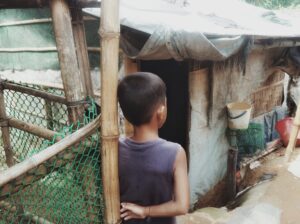
A Rohingya child stands outside a shelter in the camps in Cox’s Bazar, Bangladesh. (Picture: Akhyear Ali/LAW)
The consequences also live in the body. I have a kidney stone condition. The medical services in the camp do not provide the operation needed, and I cannot afford treatment outside. Illness becomes heavier when movement, money, and access are limited.
Camp life is also a life of restrictions. We cannot move freely. We live inside barbed wire fences. The shelters are small, and there is little privacy. If someone speaks inside the home, another family member can hear it. This creates tension inside families. In Myanmar, our houses were not so congested. Here, shelters are close together, and children grow up hearing words and worries they should not have to carry. Parents cannot simply admit a child into formal school at the age when learning should begin. Children also grow up with insecurity around them. Many cannot see certainty in their future.
I do not want readers to see me only as a refugee or survivor. I am a student. I am a community worker. I help people and conduct awareness sessions on issues affecting the community. Rohingya youth have talent, dreams, and the ability to contribute. We want to regain the respect that was violated.
For me, justice means truth. It means that perpetrators must be held accountable. Where there is justice, there should be safety, equal rights, freedom of movement, and dignity. Dignity means living as a human being, with education, self-identity, freedom, and a standard life.
The world should not only remember children as victims. It should ask what must be restored after a child loses home, school, safety, health, movement, and certainty. Statements alone cannot change our lives. Sympathy alone cannot give a child formal education, proper treatment, freedom of movement, or peace. No child should face violence, displacement, fear, or the loss of certainty because of conflict.
I was once a child who was told he was foreign in the land where he was born. Then I became a child forced to flee that land. Now I am a young person still studying, working, helping my family, serving my community, and waiting for justice.
We, the Rohingya children and youth, are also human beings. We have dreams and talents. Do not stop at sympathy. Give us the opportunity to regain our dignity, receive education, get justice, and live a peaceful life.
*Name has been changed to protect the author’s identity.