Rohingya artists paint memories of home and hopes for justice
Inside the world’s largest refugee settlement, a frst of its kind community-led art exhibition explored memory, identity and the possibility of a safe return.
1 September 2026 | Cox’s Bazar, Bangladesh
From 24 to 31 August 2026, the Rohingya Centre in Cox’s Bazar Camp 10 was filled with images of a homeland their creators remember but cannot yet safely return to.
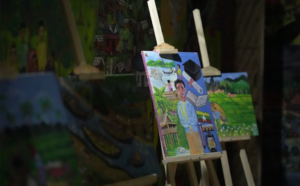
Presented under the title Nine Years On: Rohingya Aspirations for Justice, Dignity and Home, the works portrayed cultural life in Myanmar, the violence of forced displacement and the realities of prolonged exile. Moreover, the artwork answered a key questions for Rohingya survivors: What justice for the atrocities they lived could look like?
The paintings were created earlier that month during collaborative sessions between Rohingya Survivor Advocates working with Legal Action Worldwide (LAW) and artists from Artolution. Participants used colours to portray their history and express ideas of identity, belonging and a safe future.
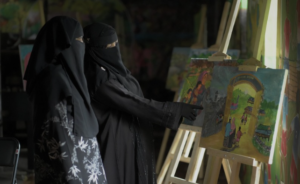
Community members view an artwork reflecting Rohingya identity, collective memory and aspirations for a safe return home.
The exhibition marked the Ninth Rohingya Genocide Remembrance Day after the 2017 genocidal “clearance operations’ by the Myanmar’s military forced more than 700,000 Rohingya to flee Myanmar for Bangladesh.
“The exhibition shows how we lived in Myanmar and the memories we continue to carry,” Rahim* (25), one of the participating artists said. “Some are painful, but they are part of our history. We want our children to remember where they come from, and we hope for a future where we can return home safely, with dignity and justice.”
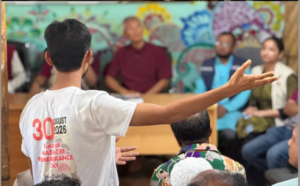
Over 8 days of the exhibition, community members and humanitarian workers visited the centre, met the artists and heard the experiences behind the paintings.
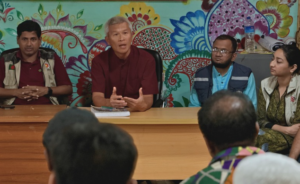
At the closing event, Nhu Nguyen Tran Minh, Head of the World Health Organization Sub-Office in Cox’s Bazar, emphasised that humanitarian support must look beyond essential services. He highlighted recreation, creativity and self-expression as important to wellbeing and as ways for communities to communicate their experiences.
While the International Court of Justice is expected to render its judgement on The Gambia v. Myanmar case later this year, the paintings translated justice into immediate, human terms: recognition, safety, dignity and the prospect of a safe, voluntary and dignified return home.
The exhibition was presented by Rohingya artists and survivors together with Legal Action Worldwide, Artolution and the Danish Refugee Council, with funding from the European Union.