
How does LAW work to advance justice for CRSV at each stage of the process, from the frontline to the courts?
Accountability & Rule of Law - Gender Equality & GBV - Global - Advocacy - Legal Aid & Empowerment - Strategic Litigation - Technical Assistance
The UN Secretary-General’s latest report on conflict-related sexual violence (CRSV) sends a clear signal: these crimes are widespread, systematic and deliberate. For the first time, both Israeli and Russian armed and security forces are listed for committing or being responsible for patterns of rape or other forms of sexual violence, including in detention.
In Palestine, the UN report documents verified cases involving 14 men, 7 women, 9 boys, and 1 girl attributed to Israeli security forces, largely in the context of detention and interrogation. In Ukraine, the UN has verified 310 cases of CRSV, affecting 280 men, 26 women, and 4 girls, with most cases occurring in detention or captivity.
These figures, while stark, reflect only a fraction of the true scale, as underreporting, stigma, and lack of access continue to severely limit documentation. Our teams at LAW have documented targeted use of sexual violence for years in Myanmar, South Sudan, Sudan, Somalia, all also named in the Secretary General’s report. However, for survivors, recognition at the UN level does not automatically translate into justice.
Across contexts, LAW works to ensure that survivors of CRSV are heard, supported and represented. Our work spans immediate frontline response in the displacement camps in Sudan to supporting Rohingya survivors in bringing landmark testimony to the International Court of Justice.
-
FIRST RESPONSE
SUDAN – Supporting CRSV survivors in refugee camps.
Addressing these crimes starts on the frontline. Survivors often face multiple hardships at once: in addition to CRSV, they may have lost family members, lost their home, be displaced (sometimes multiple times over). They may not have access to essential services to support themselves or their families.
To respond to CRSV that occurred in Sudan, LAW and our brilliant local partners, have established a Women’s Centre in Adré refugee camp, eastern Chad, staffed by lawyers, paralegals, case managers, and a psychologist. The Women’s Centre functions as a one-stop, confidential and survivor-centred space where survivors could access legal information, individual legal consultations, documentation support, psychosocial services, medical referrals, and accountability pathways. staffed by lawyers, paralegals, case managers, and a psychologist.
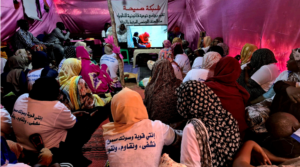
“For the first time since I fled Sudan, someone listened to my story and explained my rights. The legal support helped me understand that what happened to me was a crime and that I could seek justice.” – shared Hawa* living in the refugee settlement.
By documenting these violations, LAW ensures that survivors are not only receiving immediate support and protection but are also able to pursue accountability and have their experiences recognised through relevant justice mechanisms at the national, regional or international level.
“When we ask people what justice mean to them, one of the first answers that comes, regardless of where the crimes have been committed, is the need for an acknowledgement of their sufferings. Formally recording and submitting evidence to a Court is, in itself, answering part of what victims and survivors expect from international justice mechanisms”, said Antonia Mulvey, LAW’s Executive Director.
This is precisely what LAW’s teams have been doing in Kenya. In early June 2026, alongside our partner The African Centre for Justice and Peace Studies (ACJPS), LAW filed the first ever war crimes complaint against ten mid-to senior-level commanders of the Rapid Support forces (RSF), with prosecutors in Nairobi. The 196-page complaint was officially received by the office of the Director of Public Prosecutions (DPP). It contains evidence meticulously collected by out teams over two years. We are confident that after reviewing the complaint, the DPP will order an investigation. The fact that our clients’ testimonies were officially acknowledged by a State that has the legal framework to act, is already an important first step towards accountability.
-
DOCUMENTATION
UKRAINE – Trainings for law enforcement and lawyers
In Ukraine, Russian armed and security forces use sexual violence as a weapon. This is especially the case in detention facilities, where male prisoners of war experience sexual violence on a massive scale. These crimes are amongst the hardest to investigate, as survivors carry immense trauma and stigma, making it very difficult for them to speak about what happened. Investigations are further complicated by the challenges of gathering and properly documenting evidence, especially when incidents occur in temporarily occupied territories or active combat zones.
To improve access to justice for survivors of CRSV in Ukraine, LAW’s work focuses on strengthening the capacity of individuals and systems responsible for documenting these crimes. A key component has been a series of trainings that bring together law enforcement officials, lawyers, and psychologists to exchange experience and build more survivor-centred approaches.
LAW’s trainings are practical and built around peer exchange: police, prosecutors, investigators, lawyers, and NGO workers come together to share their experiences and talk openly about how their work can be more survivor-centred.
Participants at the latest training in Odesa, southern Ukraine, practiced building trust with survivors, collecting and preserving evidence without causing further harm, and handling deeply sensitive testimonies with care. The sessions also looked at the growing use of digital tools, like Open-Source Intelligence (OSINT), to support documentation and keep evidence safe.
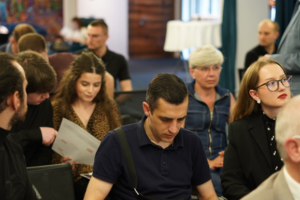
Training in Odesa
Trust between survivors and law enforcement in Ukraine has historically been fragile. War only intensifies these barriers, adding layers of trauma, displacement, and even greater stigma for male survivors of CRSV.
“Many victims fear being retraumatized, judged by society, or treated insensitively by law enforcement. The main barriers include the length of investigations, victims’ lack of awareness of their rights, the complexity of legal procedures, fear of retaliation, and a lack of trust in the effectiveness of the justice system,” says Tetiana, a lawyer and a participant in the training in Odesa.
Rebuilding that trust is neither quick nor easy, but it is essential. Without it, even the strongest legal frameworks will fall short in cases of CRSV. Strengthening accountability, therefore, begins not only with evidence, but with empathy – creating conditions where survivors feel safe enough to come forward, and confident that their voices will matter.
-
MOVING TO THE COURT
ROHINGYA – From the camps to the World Court
For Rohingya survivors of conflict-related sexual violence (CRSV), the road to justice has been long. More than a million people have been living in refugee camps in Cox’s Bazar, Bangladesh, having fled the Myanmar military’s genocidal “clearance operations” in 2017. Many experienced brutal sexual violence, killings, displacement and the destruction of their homes and livelihoods.
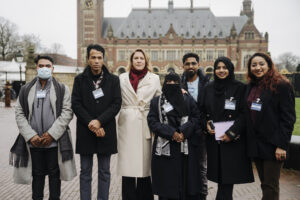
Rohingya survivors delegation alongside LAW’s founder and Executive Director Antonia Mulvey and LAW staff outside the ICJ during full merits hearings in The Gambia vs Myanmar case (Photo: DUST/LAW)
For Rohingya survivors, participation in international justice is not just a legal process, but a critical means of reclaiming agency and championing their own rights. This requires trust, security and informed consent, ensuring Rohingya clients retain control over how their experiences are shared. Over the past seven years, LAW has worked directly with Rohingya living in the camps to make their participation in the international justice processes possible – supporting survivors without reducing them to evidence.
This work helps bring Rohingya experiences into international legal proceedings. LAW contributed hundreds of pages of testimony and groundbreaking research on the long-term impacts of sexual violence, to The Gambia’s case against Myanmar at the International Court of Justice (ICJ), alleging violations of the Genocide Convention.
A key milestone came in January 2026 when the ICJ held hearings on the merits of the case, when survivors were not only represented – but physically present in the court. LAW supported four Rohingya CRSV survivors in travelling to The Hague as part of The Gambia’s victim delegation, alongside three witnesses who testified before the Court. The delegation included men, a woman and a hijra survivor, reflecting the full spectrum of those affected by CRSV. At the hearings, the Court heard directly from Rohingya witnesses. One survivor spoke about sexual violence, the killing of family members, and the loss of her child. Another described being the sole survivor of a massacre in his village.
“Myanmar has been rejecting what they did to the Rohingya. They have been saying that they didn’t persecute us. I was very happy that I could speak in front of Myanmar, and tell what they did to us, in front of them. If I need to go (testify) ten more times, I am ready to go.” says witness NJ, a Rohingya female survivor of CRSV and one of the ICJ witness
Their presence was significant: it is incredibly rare for survivor-witnesses to testify in person in inter-State cases before the ICJ. By standing before the World Court, these survivors were no longer merely spoken about, but were speaking for themselves– demanding recognition, accountability and justice.
Across every context, one truth remains: justice for conflict-related sexual violence does not begin in the courtroom – it begins with the survivor. From creating safe spaces in displacement camps, to strengthening documentation systems in active conflict, to ultimately enabling survivors to stand before international courts, LAW’s work follows a single continuum. It is about ensuring that survivors are not silenced by trauma, stigma or practical barriers, but supported at every step to shape justice on their own terms. In a landscape where CRSV is often hidden, denied, or difficult to prove, this approach transforms accountability from an abstract goal into a lived reality – where survivors are not only protected and heard, but recognised as agents of justice itself.