
Protection of Civilians Week 2026 – Protecting the Protectors
Accountability & Rule of Law - Global News - Global - Advocacy
On the sidelines of the United Nations Security Council’s (UNSC) annual open debate on the Protection of Civilians (PoC) this week, LAW partnered with Canada, Australia, and a coalition of NGOs to co-sponsor a side event titled “Protecting the Protectors: Centering the Protection of Humanitarian Personnel Through the Rest.”
The event brought together senior representatives from the United Nations Department of Safety and Security (UNDSS), the United Nations Office for the Coordination of Humanitarian Affairs (OCHA), Nonviolent Peace Force, Humanitarian Outcomes, and the Center for Civilians in Conflict (CIVIC), alongside remarks from the Permanent Representative of Australia and the Deputy Permanent Representative of Canada. Legal Action Worldwide (LAW) joined partners to make the case that words of condemnation are not enough – accountability must follow.
The panel confronted a troubling reality: attacks against humanitarian personnel remain a serious and growing concern, with the detention of aid workers emerging as an increasingly alarming trend. Panellists noted that states are weaponising national security and counter-terrorism frameworks to criminalise humanitarian action, using them as a means to further their agendas in armed conflict. Panellists also highlighted the importance of ensuring that local humanitarian personnel are explicitly included in national and international policy and conversations, as they often take on a disproportionate level of risk in their provision of aid. “What we saw was an outsourcing of risk from the international community, who is hesitant to step into high-risk areas, and offloading that onto local humanitarians; again, to civilians who are taking the space,” said Joachim Kleinmann, speaking of his work as Head of Programmes at Nonviolent Peaceforce. “As we’re moving towards realisation of the grand bargain and localisation, that can’t come with a continuation of outsourcing risk.”
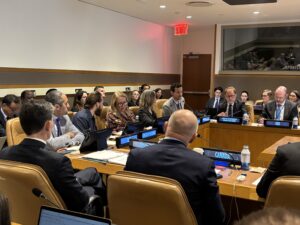
The discussion then turned to accountability as both a moral imperative and a practical tool for prevention. Nick Leddy highlighted multiple cases with a total lack of accountability. On the path forward, Nick Leddy was direct: “We have to do more than simply condemn these incidents. We have to meticulously document them, build cases, and pursue accountability.” He outlined potential pathways to secure legal accountability, including regional measures such as the African Commission on Human and Peoples’ Rights and universal jurisdiction options. When states themselves are the perpetrators, civil society must be creative in identifying other avenues of justice: “It’s when perpetrators realise they could be arrested while transiting through a third country that they might think twice about repeating this kind of conduct.”
The panel also generated strong engagement from member states, reflecting growing momentum around accountability for attacks on humanitarian personnel. There was broad consensus across the panel that political will exists and that the focus must now shift to concrete steps: enforcing arrest warrants, opening investigations under universal jurisdiction principles, and ensuring there are no safe havens for those who target humanitarian personnel.